


Uvlack: Meaning, Uses, Benefits, Applications, and Complete Guide Introduction Uvlack is a term that may look like a modern brand name or a newly invented technology, but its strongest practical meaning is connected to UV-Lack, a type of ultraviolet-curable lacquer or coating. The word is commonly associated with the European and German technical expression “UV-Lack,” […]
Uvlack: Meaning, Uses, Benefits, Applications, and Complete Guide
Introduction
Uvlack is a term that may look like a modern brand name or a newly invented technology, but its strongest practical meaning is connected to UV-Lack, a type of ultraviolet-curable lacquer or coating. The word is commonly associated with the European and German technical expression “UV-Lack,” where “UV” refers to ultraviolet light and “Lack” refers to lacquer, varnish, or finishing material. In simple terms, Uvlack describes a liquid coating that is applied to a surface and then hardened through exposure to ultraviolet light. Unlike traditional coatings that may require air drying or heat to become fully hardened, UV-curable coatings can cure extremely quickly when the correct UV light and formulation are used. This makes the technology valuable in printing, packaging, furniture, plastics, labels, commercial products, and many other manufacturing applications.
The word Uvlack can nevertheless be confusing because different websites use it in different ways. Some online articles describe Uvlack as UV lacquer or UV varnish, while other pages treat it as a brand-style term, a new technology concept, or an unrelated digital expression. Because of these differences, it is important to distinguish the established technology of UV curing from speculative or newly invented meanings attached to the spelling “Uvlack.” The most useful interpretation for printing and surface-finishing discussions is UV-curable lacquer. This guide explains what Uvlack means, how the technology works, where it is used, its advantages and limitations, different types of UV coating, its role in printing and packaging, and the questions people commonly ask about it.
What Is Uvlack?
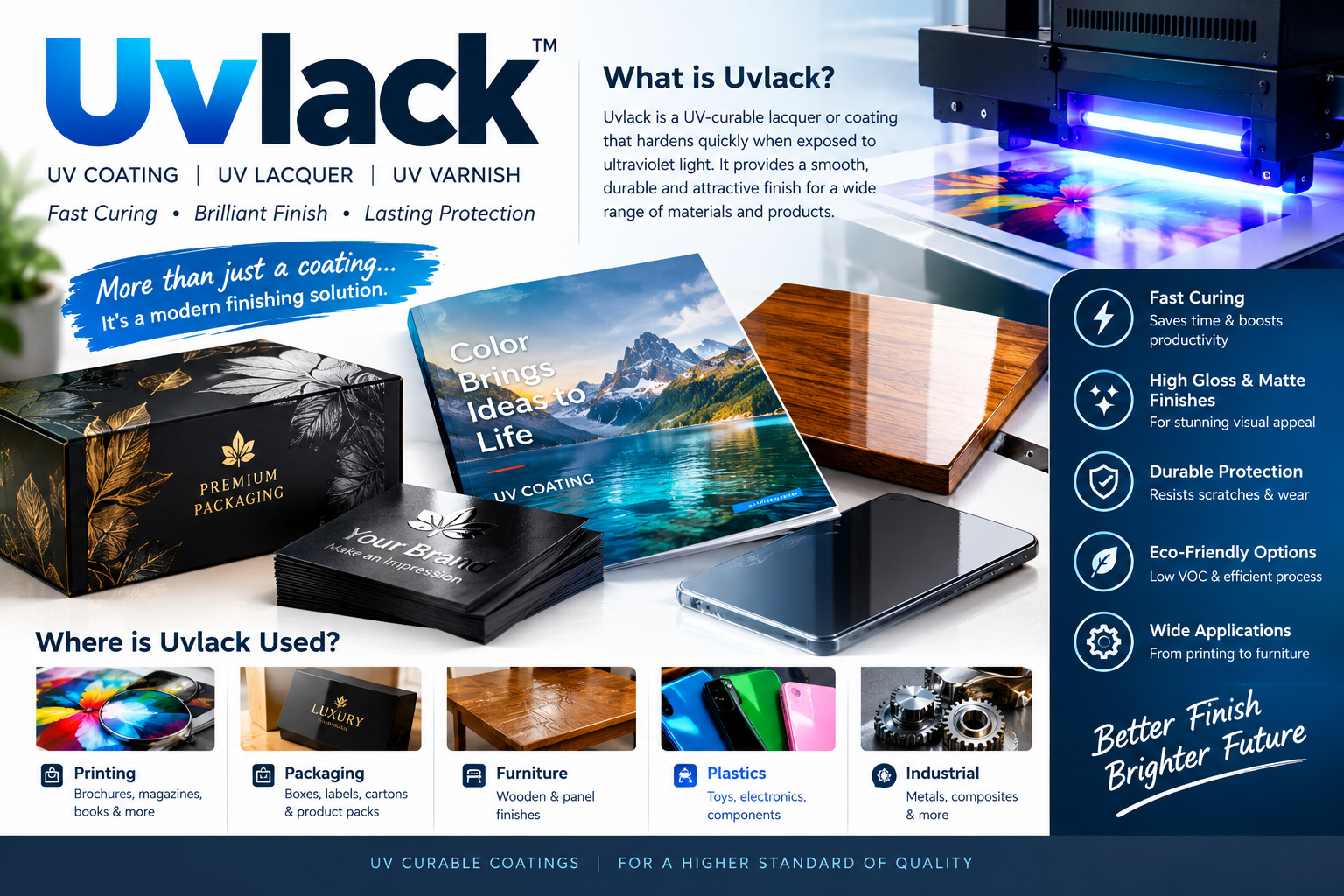
Uvlack is generally understood as a shortened or simplified spelling of UV-Lack, referring to a lacquer or varnish that cures under ultraviolet light. The basic idea is straightforward: a liquid coating is applied to a suitable surface, and controlled UV energy causes the coating to undergo a chemical reaction that changes it into a solid protective film. The final surface can have different characteristics depending on the formulation, application method, substrate, and curing conditions. It may be glossy, matte, satin, textured, or designed to emphasize particular areas of a printed product.
Uvlack should not automatically be considered one specific chemical product. Different manufacturers can produce different UV-curable lacquers for different applications. A coating designed for a premium package may have different properties from one intended for a printed brochure, wooden furniture surface, plastic component, or industrial product. Therefore, the word generally describes a category or technology rather than one universal formula. Understanding this distinction is useful because it prevents consumers and businesses from assuming that every product called UVLack has identical ingredients, performance, or application requirements.
What Does the Word Uvlack Mean?
The word becomes easier to understand when it is separated into two parts. UV stands for ultraviolet, referring to a portion of the electromagnetic spectrum used in the curing process. Lack is associated with the German term for lacquer, varnish, or coating. Together, UV-Lack describes a lacquer that is cured with ultraviolet radiation. The spelling can appear as UV-Lack, UV Lack, UVLack, UVlack, or Uvlack depending on the company, language, website, and industry context.
In English-speaking printing industries, terms such as UV coating, UV varnish, and UV lacquer are often more immediately understandable. The term Uvlack may therefore appear unusual to someone who has not worked with European printing or coating terminology. Once the two parts of the word are understood, however, its technical idea becomes much clearer: it refers to a finishing material whose curing process is activated by ultraviolet light.
How Does Uvlack Work?
The working principle behind Uvlack is based on UV curing. First, a liquid coating is applied to the surface of a suitable material. The coating contains components designed to respond to UV energy. When the coated surface passes under a properly configured UV light source, the radiation initiates a chemical reaction that causes the liquid material to polymerize and harden. Instead of remaining wet and gradually drying through evaporation or exposure to air, the coating rapidly becomes a solid film.
The speed of this process is one of the main reasons UV-curable coatings are attractive to manufacturers and printers. A production line can apply the coating and cure it quickly, allowing the finished material to move to subsequent stages without the long waiting periods sometimes associated with conventional finishes. The exact curing speed depends on factors such as coating formulation, thickness, UV intensity, equipment, surface material, and production conditions. Some UV coatings can cure extremely rapidly under appropriate industrial conditions.
Uvlack in Printing
Printing is one of the most recognizable applications associated with UV-Lack. Printers can apply UV varnish over printed material to change its appearance and provide an additional finishing layer. The coating can be applied across an entire printed surface or selectively to particular areas. This allows designers to create differences between matte and glossy sections, highlight logos, emphasize photographs, or make certain elements visually stand out.
For example, a luxury product box may have a relatively soft matte background with a glossy UV coating applied only to the company logo. When light reflects from the coated logo, it becomes more noticeable without requiring the entire package to have a glossy finish. This type of selective application is commonly called spot UV. It can provide a premium visual effect while also giving designers more control over the final appearance of printed products.
Uvlack in Packaging
Packaging manufacturers use UV coatings because appearance and surface performance are both important when products compete for attention on shelves. A suitable coating can give packaging a smooth, glossy, matte, or specialized finish while adding another layer between the printed surface and everyday handling. Product boxes, labels, promotional packaging, cosmetics packaging, food-related packaging, and commercial cartons may use different types of finishing depending on their construction and intended purpose.
A major benefit for packaging production is that UV curing can fit into fast manufacturing processes. Once the coating has received sufficient UV energy, it can become hard quickly, reducing the need for lengthy drying areas. However, packaging applications must be carefully evaluated for compatibility, regulatory requirements, intended use, and the specific coating formulation. A UV coating suitable for one packaging application should not automatically be assumed to be suitable for every type of package.
Uvlack and Spot UV Finishing
One particularly popular use of UV coating is spot UV, in which only selected areas receive the coating. Instead of covering an entire printed sheet, the printer can apply UV varnish to specific text, photographs, logos, patterns, or design elements. This creates contrast between coated and uncoated areas and can give printed materials a sophisticated appearance.
Spot UV is especially useful for business cards, brochures, invitations, packaging, book covers, promotional materials, and premium marketing products. A designer can use a raised or glossy effect to direct the viewer’s attention toward important information. The technique demonstrates that Uvlack is not simply about protecting a surface; it can also be an important part of visual communication and graphic design.
Different Types of Uvlack Coatings
There is no single type of UV coating for every application. Manufacturers can formulate coatings with different visual and physical properties. Gloss UV coating is designed to create a shiny reflective surface that can make colors appear stronger and images more vibrant. Matte UV coating provides a less reflective appearance and can create a more understated or sophisticated finish. Satin or semi-gloss finishes sit between these two options.
There are also specialized coatings designed to create textures or raised effects. The final appearance depends on the formulation, application equipment, coating thickness, curing conditions, and substrate. Some coatings are intended primarily for printing, while others are developed for wood, plastics, furniture, electronics, industrial components, or other surfaces. This variety demonstrates why the word Uvlack should generally be understood as a broad category rather than one fixed product.
Benefits of Uvlack
One of the biggest benefits associated with UV-curable coating is fast curing. Because the coating can harden rapidly under UV light, manufacturers can reduce waiting time between finishing and subsequent production stages. This can be particularly valuable in high-volume manufacturing environments where production speed matters.
Another advantage is appearance. UV finishes can produce strong gloss, smooth surfaces, matte effects, or selective highlights depending on the chosen formulation. In printing and packaging, these effects can make a product look more refined and visually distinctive. A suitable UV coating may also provide additional resistance to ordinary surface wear, although the precise durability depends on the coating and application.
Uvlack technology can also provide production benefits because curing is controlled using UV energy rather than relying entirely on conventional evaporation or air drying. This can allow manufacturers to design compact and efficient production processes. However, the environmental and operational benefits depend on the specific formulation and equipment, so broad claims should always be evaluated on a product-by-product basis.
Uvlack Compared With Traditional Varnish
Traditional varnishes can rely on drying processes involving evaporation, oxidation, or other mechanisms, while UV lacquer is specifically designed to cure when exposed to ultraviolet energy. This difference affects production speed, equipment requirements, surface characteristics, and handling. A traditional coating may need additional time before the finished product can be stacked or processed, whereas a properly cured UV coating can be handled much sooner.
However, faster curing does not automatically mean that UV coating is better for every project. The choice depends on the substrate, desired appearance, flexibility, durability requirements, printing process, budget, and production equipment. For example, a coating that produces an attractive hard surface may not be ideal for a product that needs to bend repeatedly. Good finishing decisions therefore require an understanding of the entire production process rather than focusing on curing speed alone.
Uvlack and Furniture Finishing
UV-curable coatings are also associated with wood and furniture finishing. In suitable manufacturing environments, UV technology can be used to create hard, attractive surfaces on furniture components and panels. Manufacturers can select different finishes depending on whether they want a high-gloss appearance, a low-sheen surface, or another decorative effect.
The rapid curing process can be particularly useful in factory production because finished components can move through production stages quickly. This can help manufacturers maintain consistent schedules and reduce the physical space needed for conventional drying. The exact suitability of a UV coating depends on the wood species, surface preparation, coating system, equipment, and final product requirements.
Uvlack on Plastics and Other Materials
UV-curable coatings are not limited to paper. Depending on the formulation, specialized UV coatings may be used on plastics, wood, metals, composites, and other manufactured surfaces. The coating can improve appearance and provide a particular type of surface finish. In product design, this can be useful when manufacturers want a clean, consistent, premium-looking exterior.
However, different materials respond differently to coatings. Adhesion, flexibility, surface energy, heat sensitivity, and chemical resistance can all affect performance. A coating designed for paper cannot automatically be transferred to a plastic or metal surface without testing. Professional manufacturers therefore select coatings according to the material and the intended application.
Limitations of Uvlack
Despite its advantages, Uvlack technology has limitations. One important consideration is equipment. UV curing requires appropriate UV light sources and controlled production conditions. Small businesses or individuals may therefore find conventional finishing methods easier or more economical for small projects.
Another limitation involves flexibility. Some cured coatings create a hard film, and certain hard finishes can be more vulnerable to cracking when a coated product is sharply folded or repeatedly bent. This is one reason printers consider the intended use of a product before choosing a particular coating. Some applications may be better served by flexible coatings, aqueous finishes, or lamination.
Surface compatibility is another important factor. The coating needs to adhere properly to the substrate, and the final result depends on preparation and application conditions. A technically advanced coating cannot compensate for poor surface preparation or unsuitable materials.
Is Uvlack the Same as UV Coating?
In many contexts, Uvlack and UV coating refer to essentially the same general technology. Both terms describe coatings that are cured through ultraviolet energy. However, terminology varies between countries, manufacturers, and industries. “UV coating,” “UV varnish,” “UV lacquer,” and “UV-Lack” may be used to describe related products, but the precise formulation can differ.
This means that buyers should look at the technical specifications rather than relying solely on the name. Two products may both be marketed as UV coating while having different gloss levels, hardness, flexibility, adhesion properties, or recommended applications.
Is Uvlack a Brand or a Technology?
The answer depends on context. In printing and finishing discussions, Uvlack is most strongly associated with the broader concept of UV-curable lacquer. However, the exact spelling UVLACK can also be used as a brand-style name. Recent online sources have reported a 2026 U.S. trademark application using the UVLACK name for a different collection of products, showing why the exact context matters.
Therefore, readers should not assume that every reference to UVLACK describes printing varnish. When the word appears on a specific commercial product, trademark listing, or company website, it should be investigated in that particular context.
Why Is Uvlack Confusing Online?
The internet contains several competing explanations of Uvlack. Some pages describe it as UV lacquer, while others present unrelated definitions involving digital platforms, conceptual terminology, or newly created brands. This makes the term appear more mysterious than it really is. The underlying UV-curing technology is well established, but the exact spelling “Uvlack” is not used consistently across every English-language source.
This is an important reminder to evaluate unusual keywords carefully. A website may publish a definition simply because a keyword is receiving searches, without providing strong evidence for the claimed meaning. When researching Uvlack, readers should look for information connected to printing, coatings, materials, UV curing, and established industrial applications.
How to Choose the Right UV Coating
Choosing a UV coating requires consideration of the material, desired appearance, production process, durability requirements, and budget. For printed packaging, the designer may want a glossy finish or selective spot coating. For furniture, durability and surface appearance may be more important. For industrial components, chemical resistance, adhesion, and wear performance may become major priorities.
The application process should also be considered. Professional UV coating systems require suitable equipment and controlled curing conditions. Testing is particularly important when a coating is being introduced to a new material. A sample or trial run can reveal problems with adhesion, appearance, flexibility, curing, or surface compatibility before full-scale production begins.
The Future of Uvlack and UV-Curing Technology
The broader field of UV-curable coatings is likely to remain important as manufacturers continue searching for efficient finishing methods. Developments in coating chemistry, curing equipment, surface preparation, and automated production can improve the performance and versatility of UV systems. Digital printing and modern packaging design may also continue to create demand for specialized finishing effects.
At the same time, sustainability requirements and workplace considerations are likely to influence the development of future coating systems. Manufacturers may continue researching formulations that provide strong performance while reducing undesirable materials and improving production efficiency. The future of Uvlack therefore depends less on the unusual word itself and more on continued innovation in UV-curing technology.
Frequently Asked Questions About Uvlack
What does Uvlack mean?
Uvlack generally refers to UV-Lack, meaning a UV-curable lacquer, varnish, or coating. It is applied as a liquid and hardened using ultraviolet light.
Is Uvlack the same as UV lacquer?
In many contexts, yes. Uvlack is commonly used as a spelling variation of UV-Lack or UV lacquer, although the exact terminology varies between manufacturers and countries.
How does Uvlack work?
A liquid coating is applied to a suitable surface and then exposed to ultraviolet light. The UV energy initiates a chemical curing reaction that turns the liquid layer into a hardened film.
Where is Uvlack used?
UV-curable coatings are widely associated with printing and packaging, but specialized formulations can also be used on wood, furniture, plastics, and other manufactured surfaces.
What is spot Uvlack?
Spot Uvlack, commonly called spot UV, means applying UV coating only to selected areas of a printed design, such as a logo, photograph, headline, or pattern.
Is Uvlack glossy?
It can be. UV coatings are available in different finishes, including glossy, matte, satin, and specialized textured effects.
Is Uvlack better than traditional varnish?
It depends on the application. UV coating can offer very fast curing and attractive finishes, but traditional coatings may be more appropriate for some flexible, low-volume, or equipment-limited applications.
Can Uvlack be used on plastic?
Some UV-curable coatings are designed for plastics and other non-paper materials. However, compatibility must be checked because different plastics require different coating systems.
Can Uvlack crack?
Some hard UV coatings can crack if a coated material is sharply folded or repeatedly bent. The appropriate formulation should therefore be selected according to the flexibility requirements of the final product.
Is Uvlack a specific product?
Not necessarily. In many contexts, Uvlack describes a category or type of UV-curable coating rather than one universal formula. Specific products can have different properties and applications.
Conclusion
Uvlack is a term most strongly connected with UV-Lack, UV lacquer, UV varnish, and UV-curable coating technology. The basic concept is simple: a liquid finishing layer is applied to a suitable surface and then hardened through exposure to ultraviolet light. This allows manufacturers and printers to create attractive and durable finishes while benefiting from very rapid curing. UV coating is particularly relevant to printing, packaging, labels, commercial materials, furniture, plastics, and other manufactured products.
The most important point to remember is that Uvlack should not automatically be treated as one specific chemical product or one universal brand. Different manufacturers can create different UV-curable coatings, and the final result depends on formulation, substrate, application method, and curing conditions. The term can also appear online in unrelated contexts, so readers should always consider where they encountered it.
For printing and packaging, Uvlack can provide glossy or matte finishes, protective surface properties, and creative effects such as spot UV. Its rapid curing makes it particularly useful in professional production environments. At the same time, equipment requirements, material compatibility, flexibility, cost, and application-specific safety considerations must be evaluated before selecting a coating.
Ultimately, the simplest definition is also the most useful: Uvlack is commonly associated with UV-curable lacquer or varnish that hardens under ultraviolet light. Understanding this connection makes the unusual term much easier to recognize and explains why it has become relevant across modern printing, packaging, design, and surface-finishing industries.