





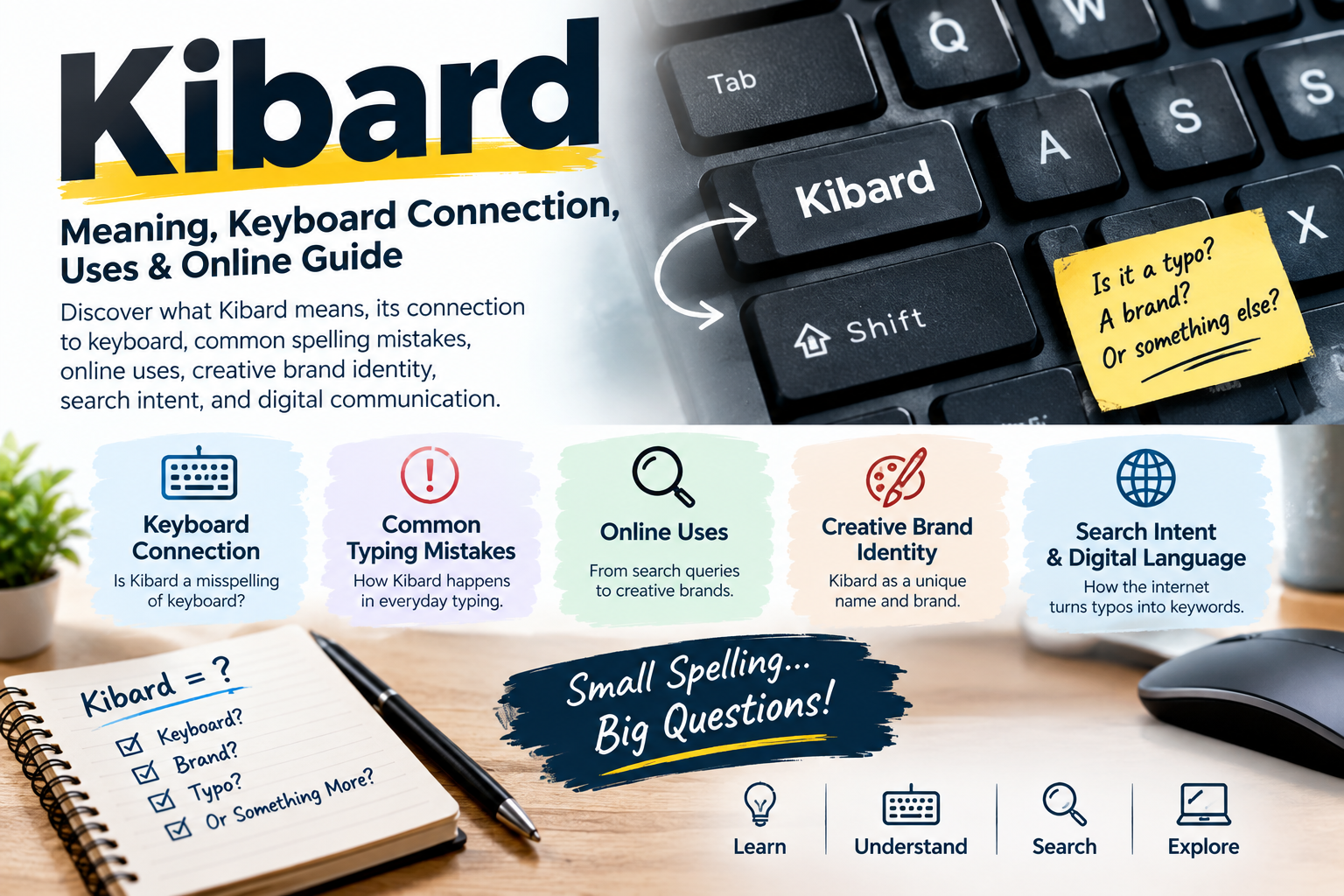
Kibard: Meaning, Origins, Keyboard Connection, Uses, and Online Significance Introduction Kibard is an unusual term that can create confusion when people first encounter it online. Unlike common English technology words, Kibard does not have one universally accepted definition. In current online usage, the term is most commonly associated with a misspelling or phonetic variation of […]
Kibard: Meaning, Origins, Keyboard Connection, Uses, and Online Significance
Introduction
Kibard is an unusual term that can create confusion when people first encounter it online. Unlike common English technology words, Kibard does not have one universally accepted definition. In current online usage, the term is most commonly associated with a misspelling or phonetic variation of the word “keyboard.” People may type Kibard accidentally while using a computer, laptop, smartphone, or voice-to-text system, and search engines can often understand what the person intended. Several recent online discussions specifically describe Kibard as a common typing mistake for keyboard.
At the same time, Kibard has appeared as a distinctive name used for creative and commercial purposes. For example, an Etsy shop operating under the name Kibard describes itself as a surreal streetwear and wearable-art brand, showing that the word can also function as a chosen identity rather than simply a typing error. Because of these different uses, understanding Kibard requires looking at the context in which the word appears. A person searching for computer accessories may mean “keyboard,” while someone encountering Kibard on a shopping platform may be referring to a specific creative brand. This article explores the different meanings of Kibard, explains why the spelling appears online, examines its connection to keyboard technology, and discusses how unusual terms can develop a life of their own on the internet.
What Does Kibard Mean?
The most common explanation for Kibard is that it is an incorrect spelling of keyboard. Recent websites discussing the term consistently describe it as a typo, phonetic spelling, or digital variation of the standard word. In this context, Kibard does not represent a separate type of computer hardware. Instead, the person using the word usually intends to find information about keyboards, keyboard accessories, typing devices, or related computer equipment.
Typing mistakes are a normal part of digital communication. People frequently type while moving quickly, concentrating on other tasks, using small smartphone screens, or relying on predictive text and voice input. When a familiar word is entered incorrectly, search engines may still understand the intended meaning. This is particularly useful for terms such as Kibard because someone who types the word may be looking for keyboard information without realizing that the spelling is incorrect. Consequently, the word can appear in search results even though it is not the standard technical spelling.
Kibard and the Word Keyboard
The strongest connection between Kibard and technology comes from its relationship with the word keyboard. A keyboard is one of the most familiar input devices used with computers and other digital systems. Physical keyboards contain individual keys that allow users to enter letters, numbers, symbols, commands, and shortcuts. On laptops and desktop computers, keyboards remain an important method of interacting with software, writing documents, searching the internet, programming, communicating, and performing professional tasks.
When someone searches for Kibard while actually intending to search for keyboard, the difference is mainly linguistic rather than technological. The user may be looking for information about mechanical keyboards, wireless keyboards, gaming keyboards, ergonomic keyboards, laptop keyboards, replacement keyboards, or keyboard shortcuts. Understanding this search intent is useful because it explains why many online results for Kibard are connected to computers and typing rather than to a distinct product called Kibard. Recent online articles about the term repeatedly identify keyboard as the likely intended word.
Why Do People Type Kibard Instead of Keyboard?
There are several possible reasons why someone might enter Kibard instead of keyboard. The first is simple typing speed. When people type rapidly, their fingers can make mistakes, letters can be omitted, or a word can be written according to how it sounds rather than according to its correct spelling. This is particularly common when someone already knows what they want to search for but is not paying close attention to every letter.
Another possibility is phonetic spelling. Some users write words according to how they hear or pronounce them, particularly when English is not their first language. A word such as keyboard may therefore be transformed into a shorter or more intuitive spelling. Voice-to-text systems can create similar variations when software interprets spoken language incorrectly. Predictive text and autocorrect can also influence what appears on a screen. Google, for example, documents automatic spelling correction and spelling suggestions in Gmail, demonstrating how modern digital systems routinely identify and correct common spelling mistakes.
Kibard and Mobile Typing
Mobile devices have changed the way people communicate and search for information. Instead of typing on a large physical keyboard, users often enter text on relatively small touchscreen keyboards. This makes accidental taps more likely, especially when someone is typing quickly. Mobile typing can therefore contribute to unusual spellings and shortened forms of words.
The situation becomes even more interesting when users combine mobile typing with predictive text. A phone may attempt to guess the next word based on previous typing patterns, while voice input may convert spoken language into written text. If a system does not correctly recognize a word, the resulting spelling may be different from what the speaker intended. Terms like Kibard demonstrate how human language and digital technology interact. A spelling mistake that would once have disappeared may now become visible in search results, messages, websites, social media posts, and online discussions.
Is Kibard a Real English Word?
In the context of standard English and technology terminology, Kibard is generally not treated as the standard spelling of a separate technical concept. Current online explanations primarily describe it as a misspelling or variation of keyboard. However, saying that a term is not a standard English word does not mean that nobody can use it as a name.
The internet allows almost any unusual combination of letters to become a username, brand, store name, project name, or creative identity. Kibard provides an example of this broader phenomenon. The same spelling can therefore have different meanings depending on where it appears. A search query containing Kibard may represent an accidental spelling mistake, while a product page containing Kibard may refer to an intentional brand name. Context is therefore essential when interpreting the word.
Kibard as a Creative Brand
One documented example of intentional use of the name Kibard can be found on Etsy. The shop describes itself as “Surreal streetwear for outsiders” and explains that its creator uses AI-generated ideas together with tools such as Adobe Illustrator and Photoshop to develop imaginative artwork for wearable products. The shop offers designs including colorful, surreal, futuristic, nature-inspired, and cyberpunk-style clothing.
This example demonstrates how an unusual word can become a recognizable creative identity. The name does not need to have a traditional dictionary definition to work as a brand. In fact, an unfamiliar name can sometimes help a creator distinguish a project from ordinary vocabulary. Kibard in this context is not being used to mean keyboard; it is functioning as the name chosen by a creative seller. This is why users should not automatically assume that every appearance of Kibard refers to a typing mistake.
Kibard and Search Intent
Search intent refers to what a person is actually trying to find when entering a query into a search engine. Kibard is an interesting example because the literal spelling and the intended meaning may be different. Someone entering “Kibard” may actually want a keyboard, information about keyboards, or an explanation of the unfamiliar word itself.
Search engines are designed to understand user intent rather than simply match letters exactly. When a query appears to contain a common spelling mistake, search systems may provide results for the likely intended word. This helps users find useful information without having to repeat their search several times. Spelling correction is already a normal feature of many digital services; Google’s documentation, for example, explains that common misspelled words can be automatically corrected in Gmail.
Why Search Engines Matter for Terms Like Kibard
The internet has changed the way language develops. In the past, a spelling mistake made in a private letter might have been seen only by a few people. Today, a spelling error can be entered into a search engine, published on social media, repeated in comments, indexed by websites, and encountered by thousands of users. As a result, unusual spellings can become recognizable search queries.
Kibard illustrates this process particularly well. Several websites published in 2026 discuss the term specifically because people search for it and want to know what it means. This does not necessarily mean that Kibard has developed into a formal English word. Instead, it demonstrates how online behavior can give a typo enough visibility to become a topic worth explaining.
Kibard and SEO
From an SEO perspective, unusual search terms such as Kibard can be interesting because they reveal the difference between exact spelling and search intent. A website that publishes an article about Kibard may be addressing people who typed the term into a search engine and want clarification. The article can then explain that the likely intended word is keyboard while also discussing other documented uses of Kibard.
However, responsible SEO writing should avoid presenting an uncertain term as something it is not. If Kibard is primarily used as a misspelling of keyboard, an article should clearly explain that rather than inventing a fictional technical definition. Likewise, if a real brand or store uses Kibard as its name, that use should be described separately rather than being presented as the universal meaning.
Kibard as a Search Keyword
A keyword does not always have to be a correctly spelled dictionary word. Search behavior frequently includes abbreviations, slang, names, incomplete phrases, and typing mistakes. Users do not necessarily formulate queries like formal sentences. They often type whatever comes to mind at the moment.
This makes Kibard an example of a behavior-driven keyword. Its significance comes partly from the fact that people enter it into search systems. Someone might type Kibard after seeing the word somewhere else, after making a typing mistake, or because they are unsure how keyboard is spelled. Once the search is made, the user may discover that the intended subject is actually a keyboard. The keyword therefore creates a path from uncertainty to information.
Common Keyboard Topics Behind Kibard Searches
If someone types Kibard while intending to search for keyboard-related information, there are many possible subjects they may actually be interested in. These can include mechanical keyboards, membrane keyboards, wireless keyboards, gaming keyboards, ergonomic keyboards, laptop keyboards, compact keyboards, programmable keyboards, and replacement keyboards.
Mechanical keyboards, for example, are popular among people who want a particular typing feel and feedback from individual mechanical switches. Gaming keyboards may include programmable keys, lighting, and features designed around gaming setups. Ergonomic keyboards are designed with different shapes or layouts intended to support more comfortable typing. Wireless keyboards can reduce cable clutter and make it easier to connect input devices to computers, tablets, and other compatible equipment. Therefore, when Kibard is interpreted as a keyboard typo, the potential subject is much broader than simply the spelling of one word.
Kibard and Digital Communication
Digital communication depends heavily on text input. People write emails, messages, articles, reports, comments, social media posts, and search queries every day. Even small spelling mistakes can therefore occur millions of times across different platforms. Kibard represents a tiny example of a much larger phenomenon in which technology influences how language is written.
The development of predictive text, autocorrect, speech recognition, and artificial intelligence has made this relationship even stronger. Users increasingly expect technology to understand imperfect language. Instead of requiring every search query to be perfectly spelled, modern systems often attempt to infer what the user means. This makes unusual words such as Kibard less of a barrier to finding information.
Is Kibard a Brand, Name, or Typo?
The answer depends entirely on context. If someone writes “I need a Kibard for my computer,” they may have simply misspelled keyboard. If someone visits a shop operating under the name Kibard, the word may refer to that specific creative brand. Etsy currently lists a Kibard shop with a collection of surreal and artistic clothing products, confirming that the name is intentionally used in at least one commercial context.
There are also websites that discuss Kibard as a possible name, digital identity, or unusual online term, but these interpretations should not automatically be treated as established definitions. Search results for obscure terms can contain speculative or low-quality explanations. The safest approach is to identify the source and context before deciding what Kibard means.
How to Avoid Confusion When Searching for Kibard
If you searched for Kibard and actually wanted information about computer keyboards, using the standard spelling keyboard will generally make your search more direct. You can then add specific terms such as “mechanical keyboard,” “wireless keyboard,” “gaming keyboard,” “keyboard shortcuts,” or “keyboard buying guide” depending on what you need.
If you intentionally searched for Kibard because you encountered it as a brand or name, adding contextual words can help. For example, searching for “Kibard Etsy” can lead toward the documented creative shop, while searching for “Kibard keyboard” makes the intended relationship with the technology term clearer. Context is especially useful for unusual words that have more than one online use.
The Future of Unusual Digital Words
The story of Kibard demonstrates a broader trend in online language. The internet continuously produces new spellings, abbreviations, names, usernames, brand identities, and accidental terms. Some disappear quickly, while others become recognizable enough to attract searches and discussions.
Artificial intelligence may make this process even more interesting. As AI-powered systems become better at understanding context, users may become less concerned about perfect spelling because they expect technology to understand what they mean. At the same time, unusual terms may become more visible because AI systems, search engines, websites, and social platforms process enormous amounts of user-generated language. Kibard is therefore a small but useful example of the constantly changing relationship between language and technology.
Frequently Asked Questions About Kibard
What does Kibard mean?
In most current online discussions, Kibard is described as a misspelling or variation of keyboard. However, Kibard is also used as a creative brand name in at least one documented online shop.
Is Kibard the correct spelling of keyboard?
No. The standard English spelling for the computer input device is keyboard. Kibard is generally an incorrect or alternative spelling when used in that context.
Why do people type Kibard?
Possible reasons include fast typing, accidental key presses, phonetic spelling, mobile touchscreen mistakes, autocorrect, and voice-to-text errors. Recent online discussions specifically connect the term with these types of digital input mistakes.
Is Kibard a technology product?
There is no strong evidence from the sources reviewed that Kibard is a standard technology product or recognized type of keyboard. In most technology-related searches, the word appears to be connected to the intended term keyboard.
Is Kibard a brand?
Kibard is used as a brand name by at least one Etsy seller. The shop presents Kibard as a surreal streetwear and creative wearable-art identity.
Can Kibard be used as a keyword?
Yes. Any term that people actually enter into search engines can function as a search keyword. Kibard is particularly interesting because it may represent a typo-based search query whose intended subject is keyboard.
Is Kibard a dictionary word?
Kibard is not generally recognized as the standard English term for a keyboard. Its most common online explanation is that it is a misspelling or variation of keyboard.
What should I search if I want keyboard information?
Use the correct spelling keyboard and add a specific phrase describing your need, such as “mechanical keyboard,” “wireless keyboard,” “gaming keyboard,” “laptop keyboard,” or “keyboard buying guide.”
Conclusion
Kibard is an unusual online term with more than one possible context. Its most common modern interpretation is as a misspelling or variation of keyboard, often created through fast typing, mobile input, phonetic spelling, autocorrect, or voice-to-text errors. Current online discussions consistently connect the term with keyboard-related searches and digital typing behavior.
At the same time, Kibard demonstrates how a strange or accidental spelling can become meaningful in another context. A documented Etsy shop uses Kibard as a creative identity for surreal streetwear and wearable artwork, showing that the word can also function intentionally as a brand name. This distinction is important because not every occurrence of Kibard has the same meaning.
Ultimately, Kibard provides an interesting example of how language works in the digital age. A small typing mistake can become a searchable term, while an unusual collection of letters can also become a memorable brand. As search engines, artificial intelligence, predictive text, and voice technologies continue to develop, the boundary between traditional vocabulary, accidental spelling, and intentionally created digital language will continue to evolve. Understanding the context behind a term like Kibard is therefore the best way to determine what the person using it actually means.



Hello,
I was reviewing generalnewsblogs.com and believe we can establish a strong, long-term business relationship supplying top-tier quality products.
Through our platforms at https://pharmakarts.com/ and https://weednpills.com/, we specialize in premium catalog offerings backed by completely discreet shipping and hassle-free delivery networks designed for absolute reliability.
We are looking to partner with professional operators to ensure consistent availability and seamless service.
Check out our catalog options or reach out directly to discuss how we can support Generalnewsblogs:
→ WhatsApp: +447901244514
→ Telegram: @Deliverysupportsbot
Best regards,
David
Pharmakarts & Weednpills Team
Email: info@pharmakarts.com
Dear
Thank you for reaching out and expressing your interest in collaborating with Generalnewsblogs.com.
We are open to establishing a long-term business partnership with your team. Our standard publishing rate is **$50 per guest post**, subject to our editorial guidelines and content approval.
Additionally, we have access to a network of **2,000+ high-quality websites** across various niches, offering excellent opportunities for content placement and brand exposure.
If you are interested in working with us, please feel free to get in touch. We would be happy to share our complete website list, along with pricing and other relevant details.
We look forward to building a successful and mutually beneficial business relationship.
Thanks.