


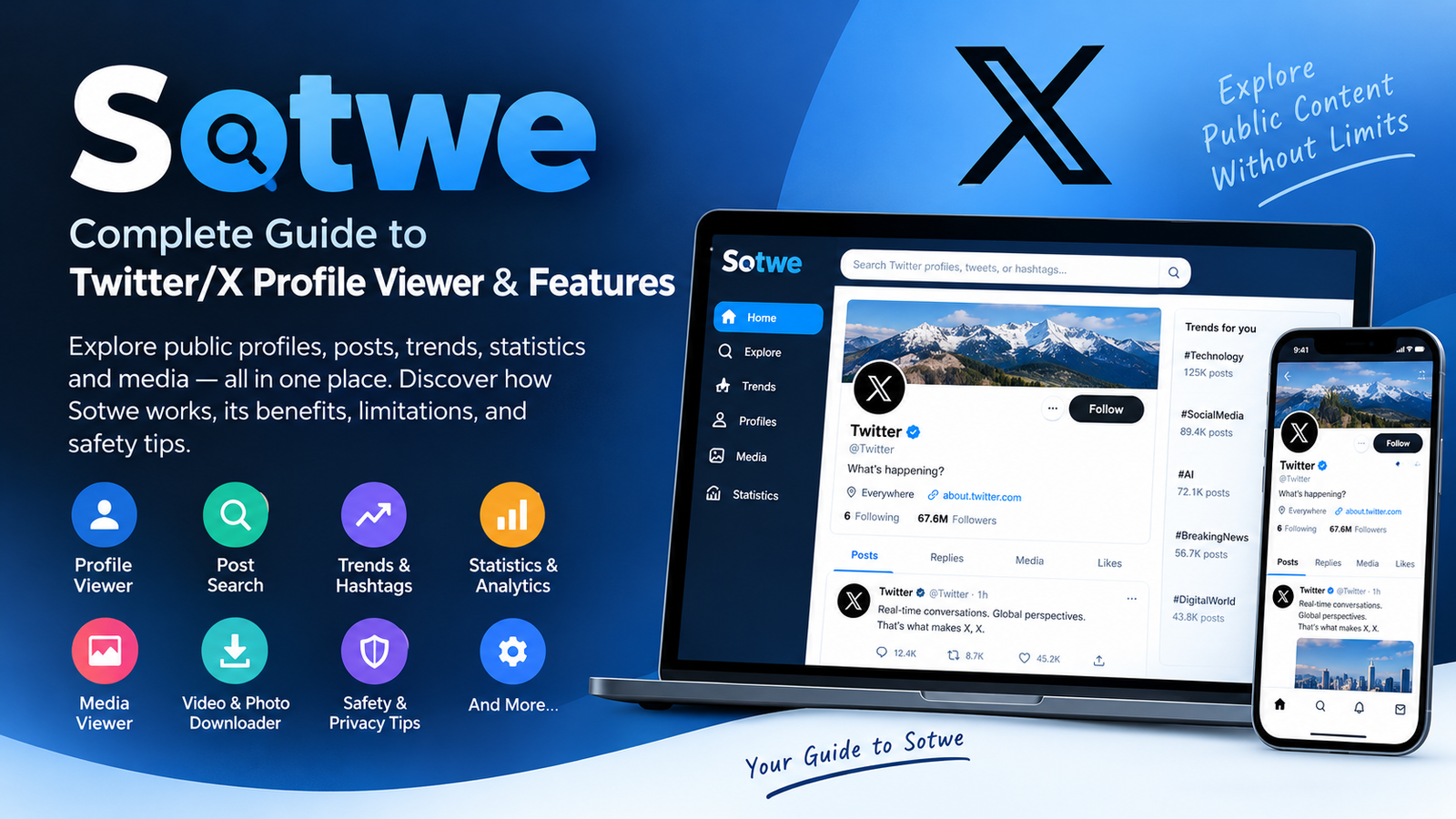
Sotwe: A Complete Guide to the Twitter/X Web Viewer Introduction Social media has become one of the fastest ways to discover news, opinions, trends, entertainment, and conversations from around the world. X, formerly known as Twitter, is particularly important because millions of public posts are shared there every day. However, not everyone wants to create […]
Sotwe: A Complete Guide to the Twitter/X Web Viewer
Introduction
Social media has become one of the fastest ways to discover news, opinions, trends, entertainment, and conversations from around the world. X, formerly known as Twitter, is particularly important because millions of public posts are shared there every day. However, not everyone wants to create an account or log in simply to read a public profile or check a particular post. This is where third-party viewing services such as Sotwe have attracted attention. Sotwe is described by its own website as a free service that allows users to explore Twitter profiles and statistics and download Twitter videos and photos. Its About page also states that it uses the Twitter API and is not endorsed or certified by Twitter.
Sotwe can therefore be understood as an alternative interface for exploring publicly available Twitter/X content. Instead of using the standard X interface, users may be able to search for public profiles, examine posts, discover trends, and access publicly available media through a separate website. This makes the service interesting to casual users, researchers, journalists, marketers, and anyone who wants to look at public social media information without going through the complete experience of the official platform. At the same time, because Sotwe is a third-party service rather than X itself, users should understand its limitations, availability, privacy considerations, and the possibility that its features can change as the underlying social-media platform changes.
What Is Sotwe?
Sotwe is a web-based third-party service associated with viewing publicly available Twitter/X content. Its original site describes itself as a service for exploring Twitter profiles and statistics, with additional functionality for downloading publicly available Twitter videos and photos. The site specifically explains that it is not endorsed or certified by Twitter, which is an important distinction when discussing what Sotwe actually is.
Unlike X itself, Sotwe is not primarily a social network where users create posts, communicate through direct messages, follow accounts, and participate in conversations. Instead, its purpose is centered on viewing and discovering public information. Current descriptions of Sotwe commonly identify functions such as public profile viewing, tweet or post discovery, trend exploration, and media access. Some versions of websites using the Sotwe name also describe features such as hashtag tracking and analytics. Because multiple websites currently use the Sotwe name, users should also pay attention to the exact domain they visit and avoid assuming that every site carrying the name is operated by the same organization.
How Does Sotwe Work?
The basic idea behind a service such as Sotwe is relatively simple. A user visits the website and searches for publicly accessible information connected with an X/Twitter account, post, hashtag, or trend. The service then presents the available information through its own web interface rather than requiring the user to navigate the official X interface. This can make public information easier to browse for people who do not have an X account or who simply want a separate way to examine public content.
The exact technical method can vary between different Sotwe domains and versions. Sotwe’s own About page says that it uses the Twitter API, while other contemporary descriptions of Sotwe-like viewers describe approaches involving public-data aggregation or scraping. For that reason, it is safer to describe the service in terms of what it provides rather than making an unsupported claim about one specific technical architecture. The important point for ordinary users is that the information comes from publicly accessible social-media content and is displayed through a separate interface.
Main Features of Sotwe
One of the features most commonly associated with Sotwe is public profile viewing. A user may search for a public X/Twitter username and, where the service has access to the relevant information, see profile details and publicly available posts. This can be useful when someone wants to research an account without spending time navigating through the standard social-media interface. However, private accounts and information that is not publicly accessible should not be expected to appear.
Another commonly advertised feature is trend and hashtag discovery. Social media trends can provide a quick picture of the subjects attracting attention at a particular moment. Sotwe has been described as a Twitter trend analyzer and profile viewer, making trend discovery part of its broader purpose. For marketers and researchers, this type of information can be useful for understanding which subjects are receiving attention, although trend information should always be checked against the original platform when accuracy or completeness matters.
Media viewing and downloading is another feature associated with Sotwe. The original Sotwe About page states that users can download Twitter videos and photos through the service. When downloading content, users should remember that the ability to access a file does not automatically mean that they own the copyright or have permission to redistribute it. Public availability and copyright ownership are separate issues, so downloaded material should be used responsibly.
Why Do People Use Sotwe?
There are several reasons someone might search for a service such as Sotwe. One reason is convenience. A person may want to check a public profile or read public posts without going through the complete X experience. Another reason is research. Journalists, students, marketers, and researchers sometimes need to examine public social-media conversations as part of their work. A separate viewer can provide another way to organize or discover information.
Another possible reason is that some people prefer not to maintain accounts on every social-media platform. A no-account viewing experience can be useful for someone who only wants to read public information occasionally. Several websites describing Sotwe emphasize this no-login browsing concept. However, users should understand that third-party viewers may not always display everything available on the official platform, and their functionality can change without notice.
Sotwe and X/Twitter: What Is the Difference?
The most important difference between Sotwe and X is that they serve different purposes. X is the original social-media platform where users can create accounts, publish posts, follow other accounts, interact with content, and communicate with other users. Sotwe, by comparison, is a third-party viewing service designed around access to publicly available information.
This distinction is especially important because Sotwe should not be described as an official version of X. The Sotwe About page explicitly says that the service is not endorsed or certified by Twitter and that Twitter’s logos and trademarks belong to Twitter. Users should therefore understand that any problems, missing information, or changes in functionality on a third-party viewer are not necessarily controlled by X.
Benefits of Using Sotwe
One potential benefit of Sotwe is convenient access to public information. If the relevant content is available through the service, users can browse it through an alternative interface rather than relying exclusively on the official X website or application. This can be particularly convenient for occasional visitors who are interested in public posts but do not want to maintain another social-media account.
A second potential benefit is content discovery. Services that organize public profiles, trends, hashtags, and posts can make it easier to locate information around a particular subject. For people monitoring online discussions, this can provide a useful starting point for research. Sotwe has also been described as providing profile statistics and trend-related information, which can make it relevant to social-media monitoring.
A third benefit is media access. Sotwe’s original About page specifically advertises the ability to download Twitter videos and photos. This can be convenient when a user has a legitimate reason to save publicly available media for personal reference. Nevertheless, users should respect copyright, privacy, and the original creator’s rights when handling downloaded content.
Limitations of Sotwe
Despite its useful features, Sotwe has important limitations. The first is that it is a third-party service. This means that its availability and functionality can depend on access to X/Twitter information and on changes made by the underlying platform. If X changes its systems, access rules, APIs, or public-data availability, third-party viewers may stop working correctly or may display incomplete information.
Another limitation is that public information is not necessarily complete information. A viewer may not show every post, reply, statistic, image, or interaction that can be found through the official platform. A current OSINT directory similarly notes that Sotwe can be useful for viewing public profiles but warns that reliability can vary with platform changes and that it should not be treated as a complete archive.
There is also the issue of multiple websites using the Sotwe name. Search results currently show several domains presenting themselves as Sotwe or describing similar services. This makes it important for users to verify the website they are visiting and be cautious with unfamiliar domains, especially if a site requests unnecessary personal information, downloads, browser permissions, or login credentials.
Is Sotwe Safe to Use?
Safety depends partly on which Sotwe-branded website a person visits and how the service is used. The safest general approach is to treat third-party social-media viewers cautiously. Users should avoid entering X passwords or other sensitive account credentials into an unofficial viewer. They should also be careful before downloading unknown files, clicking unfamiliar advertisements, or granting unnecessary browser permissions.
It is also important to remember that a website displaying public information does not automatically make every piece of information accurate, current, or complete. If information is being used for journalism, academic research, business decisions, or another important purpose, it is sensible to verify the original post or profile directly on X whenever possible. This is particularly important because third-party viewers can experience delays, missing content, or technical interruptions.
Sotwe for Researchers and Social Media Monitoring
Researchers can potentially use Sotwe as a starting point for exploring public social-media conversations. For example, someone studying online discussions may search for public profiles or topics and then examine publicly available posts. Marketers may also find trend and hashtag information useful when studying how audiences discuss particular subjects.
However, third-party viewers should generally be treated as discovery tools rather than definitive archives. If a post is important, researchers should record its original source and verify the information directly where possible. A viewer may provide a convenient way to find something, but the official source remains important for confirmation. This approach is especially useful when information is time-sensitive or when a post may later be edited, deleted, restricted, or otherwise become unavailable.
Sotwe on Mobile Devices
Because Sotwe is web-based, users generally do not need to install a dedicated application simply to access the website. A browser on a smartphone, tablet, laptop, or desktop computer can provide access when the relevant site is operational. Web-based access can be convenient because it avoids the need to install another application and allows users to switch between devices.
The experience can nevertheless vary depending on the specific Sotwe domain, browser, internet connection, and current availability of the service. Users should therefore avoid assuming that a particular feature will work identically on every device. If a page fails to load or information is missing, checking the original X platform can help determine whether the problem is with the viewer or with the underlying content.
Responsible Use of Sotwe
Responsible use is important whenever a tool provides access to social-media information. Public posts can contain personal information, photographs, opinions, and other material created by individuals. The fact that something is publicly accessible does not mean that it should automatically be copied, republished, or used in any context without consideration.
Users should respect copyright and the privacy of individuals, especially when downloading or redistributing images and videos. They should also avoid using third-party viewing tools to harass, impersonate, threaten, or otherwise misuse information about other people. For professional research, keeping clear records of original sources and checking important claims can improve accuracy and reduce the risk of spreading incorrect information.
Final Thoughts on Sotwe
Sotwe is best understood as a third-party service associated with exploring publicly available Twitter/X information. Its advertised functions have included profile and statistics viewing, trend discovery, and downloading publicly available photos and videos. The original Sotwe website itself makes clear that it is not endorsed or certified by Twitter. This distinction matters because the service is separate from the official X platform and may therefore have different features, limitations, and reliability.
For people who simply want to explore public social-media content, Sotwe can provide an alternative interface. For researchers, marketers, and journalists, it may also serve as a convenient starting point for finding public information. However, users should remain aware that third-party viewers can change or become unavailable, may not provide a complete picture of an account, and should not automatically be treated as authoritative archives. Checking important information against the original source is therefore a sensible practice.
Frequently Asked Questions About Sotwe
What is Sotwe?
Sotwe is a third-party web service associated with viewing publicly available Twitter/X profiles, posts, statistics, trends, and media. Its original About page describes it as a free service for exploring Twitter profiles and statistics and downloading Twitter videos and photos.
Is Sotwe the same as Twitter or X?
No. Sotwe is separate from Twitter/X. The Sotwe About page specifically states that the service is not endorsed or certified by Twitter.
Do I need an X account to use Sotwe?
The service has traditionally been promoted as a way to explore public Twitter content without requiring the same account-based experience as the official platform. However, functionality can vary by domain and can change over time.
Can Sotwe show private Twitter/X accounts?
A third-party public viewer should not be expected to provide access to genuinely private content. Its usefulness is primarily connected with information that is publicly accessible.
Can users download videos and photos through Sotwe?
The original Sotwe About page states that its service allows users to download Twitter videos and photos. Users should still consider copyright and the rights of the original creator before redistributing downloaded material.
Is Sotwe an official X product?
No. Sotwe’s own About page states that it is not endorsed or certified by Twitter.
Is Sotwe always available?
Not necessarily. Third-party viewers depend on access to information from the underlying social-media platform, so changes to platform systems or access rules can affect their operation. Different Sotwe-branded domains may also have different availability.
Should I enter my X password into Sotwe?
Users should be cautious about entering passwords into third-party websites. If a site is simply intended to display public information, there is generally no reason to provide an X password. Users should verify the domain and avoid providing sensitive credentials to unfamiliar services.
Conclusion
Sotwe has become associated with the idea of viewing public Twitter/X content through a separate web interface. It can provide a convenient way to explore public profiles, posts, trends, statistics, and media, particularly for users who want an alternative to the standard X experience. The original service also advertises photo and video downloading and makes clear that it is not officially endorsed or certified by Twitter.
At the same time, Sotwe should be approached as a third-party viewing service rather than a replacement for X. Availability, features, and completeness can change, and multiple websites currently use the Sotwe name. Users should therefore verify important information through original sources, protect their personal credentials, respect copyright and privacy, and exercise caution when visiting unfamiliar domains. Used thoughtfully, a public-content viewer such as Sotwe can be a convenient research and browsing tool while still requiring the same care that should be applied to any third-party online service.