




Bilieter: Meaning, Origin, Uses, Ticketing Connection, and Online Presence Introduction Bilieter is an unusual term that can be confusing when first encountered online. Unlike familiar English words such as ticket, usher, attendant, or event staff, Bilieter does not have one universally established definition in standard English dictionaries. Its meaning depends heavily on the context in […]
Bilieter: Meaning, Origin, Uses, Ticketing Connection, and Online Presence
Introduction
Bilieter is an unusual term that can be confusing when first encountered online. Unlike familiar English words such as ticket, usher, attendant, or event staff, Bilieter does not have one universally established definition in standard English dictionaries. Its meaning depends heavily on the context in which it appears. Current online sources commonly connect the term with ticket collection, event entry, ushering, and ticket-related services, while other uses treat Bilieter as a name, website, or digital publication. The Polish word bileter, which is associated with a ticket collector or usher, is one important linguistic comparison when trying to understand the term.
The uncertainty surrounding Bilieter makes it an interesting subject for language research and online information searches. A person might encounter the word while looking for information about cinema tickets, theater entrances, concerts, transportation, digital ticketing, or event management. Another person may encounter Bilieter as the name of an online publication or website. There is also potential confusion with the English word billeter, which has a different historical relationship with billets and temporary accommodation. Because these words look and sound similar, it is important to examine the surrounding context before deciding exactly what Bilieter means.
What Does Bilieter Mean?
The simplest explanation is that Bilieter is an uncommon, non-standardized term whose meaning depends on context. In ticket-related situations, it can be associated with a person who checks, collects, or manages tickets at an entrance. This interpretation is closely related to the Polish word bileter, which dictionaries translate in contexts involving an usher or ticket collector.
However, it would be inaccurate to claim that Bilieter is universally defined as a ticket collector in English. The spelling itself is not widely recognized as a standard English dictionary entry. Some websites specifically describe it as a spelling variation, transliteration, or online term. Other websites associate it with digital ticketing and event planning. Therefore, the most accurate approach is to explain the likely ticket-related meaning while acknowledging that the word has multiple online uses.
This distinction is particularly important for people researching unusual keywords. A term appearing on many websites does not automatically become an official dictionary word. Search engines index websites, names, brands, usernames, translations, misspellings, and newly created terms. Bilieter is a good example of why the source and context surrounding an unfamiliar word matter.
Bilieter and the Polish Word Bileter
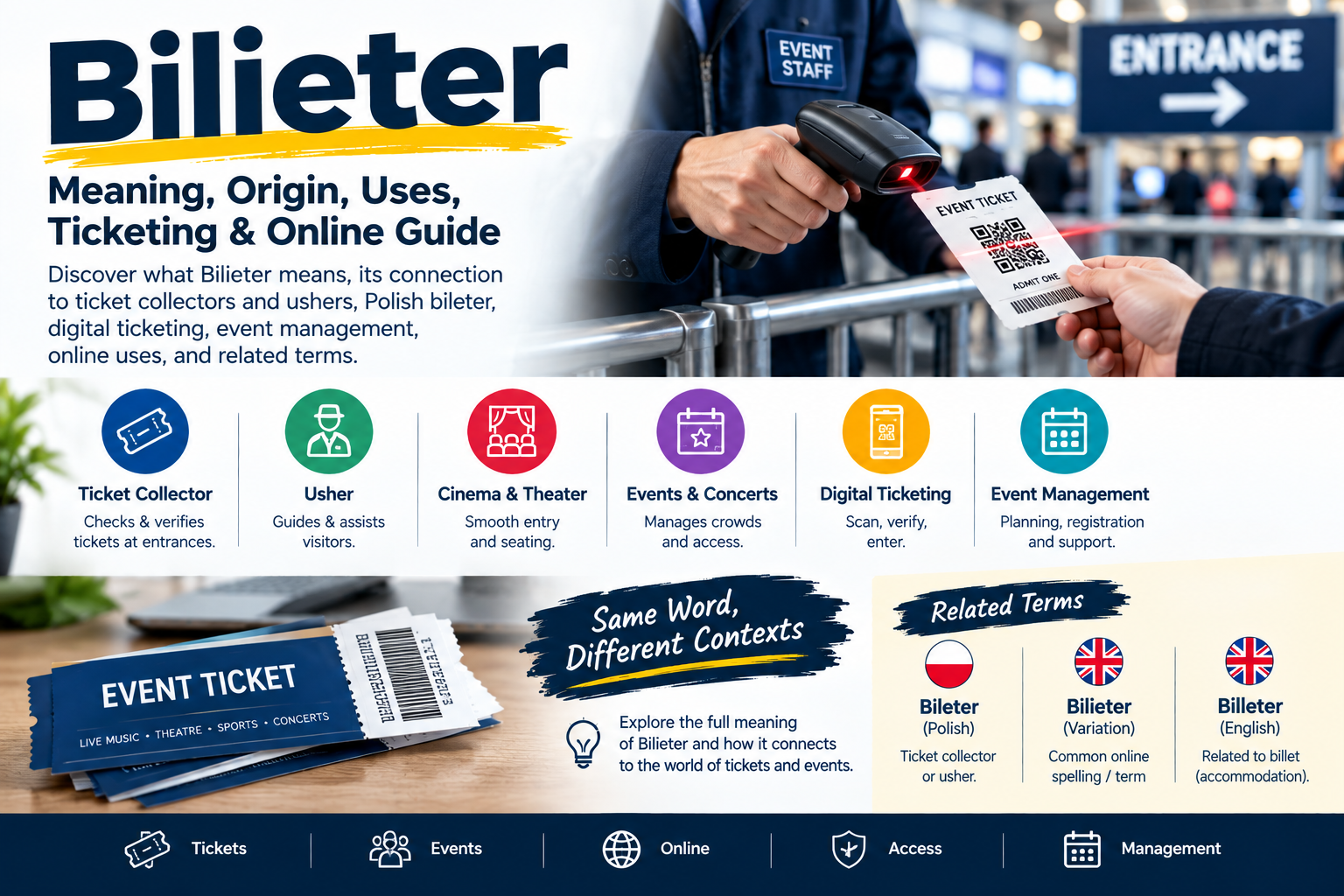
One of the strongest linguistic connections associated with Bilieter is the Polish word bileter. Current sources describe bileter as a Polish term connected with an usher or ticket collector. In practical terms, this is someone who may check admission tickets, assist people entering a venue, or help control access to a particular event.
Imagine arriving at a cinema before a movie begins. You have purchased a ticket, and an employee is standing near the entrance. The employee checks your ticket, confirms that you are attending the correct screening, and may direct you toward the appropriate theater room. In standard English, this person might be called an usher, ticket attendant, or ticket checker. The Polish term bileter can describe a similar role.
Bilieter appears to be used online as a variation of this ticket-related terminology. However, the distinction between bileter and bilieter should be maintained because one is an established foreign-language term while the other is an uncommon spelling encountered in online content.
What Does a Bilieter Do?
When Bilieter is used to describe a ticket-related role, the basic responsibilities involve controlling or assisting admission. The exact duties can vary depending on whether the person works at a cinema, theater, concert, sports venue, transportation station, exhibition, or another location where tickets are required.
One important responsibility is checking whether a ticket is valid. In a traditional setting, this could involve looking at a printed ticket and confirming the date, event, seat, or entrance information. In a modern setting, the worker may scan a barcode or QR code using a digital device. The employee may also answer questions from visitors, direct guests toward entrances or seating areas, and help resolve basic admission problems.
The role is therefore broader than simply taking a piece of paper from a customer. Ticket staff are often part of the first point of contact between an organization and its visitors. Their work can influence how smoothly people enter an event and how easily they find the correct location.
Bilieter in Cinemas and Theaters
Cinemas and theaters provide some of the clearest examples of ticket-related work. When customers arrive, someone must verify that their admission is valid and help them understand where they need to go. Depending on the venue, this person may check tickets, direct guests toward screening rooms, provide seating assistance, or answer questions about the event.
In a traditional theater environment, an usher may have responsibilities beyond ticket inspection. The person might help visitors find their seats, provide directions, manage queues, or assist with general audience services. This makes the term associated with Bilieter particularly interesting because it can overlap with several English job titles rather than representing one exact occupation.
Modern cinemas have also introduced automated ticket scanning, mobile tickets, and self-service systems. As technology becomes more common, human ticket staff may spend less time manually inspecting printed tickets and more time assisting customers with digital admission systems.
Bilieter at Concerts and Events
Large concerts, festivals, exhibitions, conferences, and sporting events can require extensive ticket-management operations. Thousands of people may arrive within a short period, meaning organizers need systems for checking admission, controlling entrances, managing queues, and directing visitors.
In this environment, ticket attendants can perform several practical functions. They may scan digital tickets, identify the correct entrance, check seating information, explain event rules, and direct attendees toward specific areas. When an event has multiple ticket categories, staff may also help determine whether a visitor has access to a particular section.
The importance of this role becomes especially visible when an event is crowded. Efficient ticket checking can reduce waiting times and prevent confusion. For this reason, ticket-management workers are an important part of the operational side of live events, even though visitors may notice them only briefly.
Bilieter and Digital Ticketing
Digital ticketing has significantly changed how admission works. Instead of receiving a printed ticket, customers can now receive tickets through websites, mobile applications, email, or digital wallets. These tickets may contain QR codes, barcodes, reservation numbers, or other forms of electronic identification.
If Bilieter is used in a modern ticketing context, it can therefore be discussed alongside the broader transition from physical tickets to digital admission systems. A ticket attendant may use a smartphone, tablet, handheld scanner, or dedicated event-management device to verify electronic tickets.
Digital ticketing can make admission faster and reduce the need for printed materials, but it can also create new challenges. Visitors may arrive with low phone batteries, damaged screens, poor internet connections, duplicate tickets, or incorrect booking information. Human staff remain useful because they can help customers resolve these problems when automated systems cannot immediately provide an answer.
Bilieter and Event Management
Ticketing is only one part of event management. Organizers must also consider registration, seating, security, crowd movement, schedules, communication, accessibility, and customer support. Ticket-related staff can contribute to several of these areas by serving as a connection between the ticketing system and the people attending the event.
A well-organized entrance requires more than simply scanning tickets. Staff may need to communicate clearly with visitors, identify problems, manage queues, and know where to send people for additional help. In larger events, different teams may handle different sections of the process, with ticket checking being only one component of a much larger operational system.
This broader perspective helps explain why online sources sometimes associate Bilieter with event planning and digital ticketing rather than with a single job title.
Bilieter vs. Bileter
The spelling difference between Bilieter and bileter is important. Bileter is documented as a Polish word connected with ticket collection and ushering. Bilieter, by contrast, is an uncommon spelling that appears in English-language online searches and publications.
The two terms may be connected in some contexts, but they should not automatically be treated as identical words in every situation. Language often changes when words move between countries and writing systems. Transliteration, pronunciation, spelling habits, and online typing can all produce variations.
Therefore, if someone is researching the word Bilieter, looking at the related term bileter can provide useful information, but the researcher should still identify the source and context where Bilieter itself appears.
Bilieter vs. Billeter
Another major source of confusion is the English word billeter. Although it looks similar to Bilieter and bileter, it has a different historical connection. English billet has historically been associated with providing or assigning temporary accommodation, particularly for soldiers. Some sources therefore use billeter for someone involved in arranging or providing such accommodation.
This means that a reader should not assume that every word beginning with “bilet” has a ticket-related meaning. Similar spellings can develop from related historical roots while eventually acquiring different meanings in different languages.
The easiest way to distinguish them is to look at the surrounding vocabulary. If the context contains words such as tickets, cinema, theater, admission, passengers, or concerts, a ticket-related interpretation is more plausible. If the context contains soldiers, accommodation, housing, quarters, or military history, the meaning may be connected to billet and billeter instead.
Why Is Bilieter Difficult to Define?
Bilieter is difficult to define because it does not appear to have one firmly standardized English meaning. Several current online sources acknowledge that the term is unusual and context-dependent.
Another problem is that search engines collect information from many types of websites. A search for an obscure term can produce dictionary explanations, personal blogs, commercial pages, brand names, AI-generated articles, translations, and unrelated uses. These sources do not necessarily have equal authority.
For this reason, someone researching Bilieter should avoid choosing the first definition they find. Instead, they should compare several sources and determine whether the same meaning appears in reliable references. This is especially important when an obscure word is connected to technical, medical, financial, or professional claims.
Bilieter as an Online Name or Publication
Bilieter is also used online as a name associated with ticketing and event-related content. One current source describes Bilieter.com as an online publication focused on digital ticketing and event planning. Its content includes subjects such as event registration, ticket design, seating arrangements, conferences, sponsorships, volunteers, and event organization.
This is an important example of why context matters. If someone sees “Bilieter” as the title of a website, it does not necessarily mean that the website is defining an English dictionary word. It may simply be a chosen name for a publication or digital project.
Names can be intentionally unusual because businesses and websites often want something distinctive. A unique name can make a website easier to distinguish from ordinary vocabulary, even if the name itself does not have a formal dictionary definition.
Bilieter and Search Engines
Search engines play a major role in making obscure words visible. A person might encounter Bilieter in a website title, social media post, comment, translation, or advertisement and then search for it. Once enough people search for a term, websites may begin publishing explanatory articles about it.
This creates an interesting cycle. A relatively uncommon term becomes searchable, websites write about it, more people encounter those articles, and the term becomes even more visible. However, increased visibility does not necessarily prove that the term has a universally accepted definition.
Bilieter demonstrates why online popularity and linguistic authority are two different things. A term can have thousands of search results without being a standard English word. Conversely, an old dictionary word may have relatively few modern search results.
How to Understand Bilieter in Context
The best method for understanding Bilieter is to examine the words surrounding it. Context often provides more information than the spelling itself.
If Bilieter appears next to ticket, cinema, theater, concert, admission, entrance, passenger, or event, a ticket-related interpretation is reasonable. The connection with Polish bileter makes this interpretation particularly relevant.
If it appears next to soldiers, lodging, accommodation, military, quarters, or housing, the intended word may actually be billeter or another form connected with the historical practice of billeting.
If it appears as the title of a website, company, publication, product, or social-media account, it may simply be a proper name. In that situation, the official website or organization should be consulted rather than relying on a general dictionary interpretation.
The Importance of Accurate Information
Researching unusual terms requires careful attention to evidence. It is easy to find a confident explanation online and assume that it is correct, especially when several websites repeat similar wording. However, repeated information is not necessarily independent confirmation.
For Bilieter, this is particularly important because current online sources provide several interpretations. Some connect it to ticket collection, some emphasize its relationship to bileter, and others treat it as an online publication or context-dependent term.
A reliable explanation should therefore acknowledge uncertainty where it exists. Rather than saying that Bilieter has one absolute definition, it is more accurate to explain its strongest documented associations and then describe the alternative contexts separately.
The Future of Bilieter and Similar Terms
As online communication continues to develop, unusual terms such as Bilieter may become increasingly visible. Search engines, artificial intelligence, social media, online publications, and international communication allow words to travel quickly between languages and communities.
A spelling variation can become a search keyword, a search keyword can become a website name, and a website name can eventually become associated with a particular subject. This process is not unique to Bilieter. Many modern internet terms have developed through similar combinations of language, technology, branding, and user behavior.
The future meaning of Bilieter will therefore depend on how people continue to use the term. If it becomes associated with a particular brand or platform, that identity may become more recognizable. If it remains primarily a variation connected with ticket-related language, it may continue to appear mostly in specialized searches.
Frequently Asked Questions About Bilieter
What is Bilieter?
Bilieter is an uncommon, context-dependent term. In ticket-related contexts, it is associated with ticket collection, ushering, admission, and event entry. It is also used online as a name or publication in some contexts.
Is Bilieter a standard English word?
Bilieter is not widely established as a standard English dictionary word with one universally accepted definition. It may be a spelling variation, transliteration, proper name, or context-specific term.
Does Bilieter mean ticket collector?
In some contexts, Bilieter is connected with the ticket-collector meaning associated with the Polish word bileter. The standard English terms would usually be ticket collector, ticket attendant, or usher.
What is the difference between Bilieter and bileter?
Bileter is a Polish term associated with a ticket collector or usher. Bilieter is an uncommon spelling that may be used as a variation or online term. The two should not automatically be treated as identical in every context.
Is Bilieter the same as billeter?
No. Billeter is associated with the English word billet and the historical practice of providing or arranging temporary accommodation, particularly for soldiers. This is different from the ticket-related meaning associated with bileter.
Where might a Bilieter work?
If the term is being used in a ticket-related sense, the role could be associated with cinemas, theaters, concerts, sporting events, transportation, exhibitions, or other venues where admission tickets are checked.
Can Bilieter refer to digital ticketing?
Some current online sources use the term in connection with digital ticketing and event planning. However, it should not automatically be treated as the name of a universally recognized technology or industry standard.
Why are there different meanings of Bilieter online?
The term is uncommon and resembles words from different languages and historical contexts. It can also be used as a website or brand name. These factors create different interpretations in search results.
Conclusion
Bilieter is an unusual term whose meaning is best understood through context rather than through a single fixed definition. In ticket-related situations, it can be associated with the Polish word bileter, which refers to a ticket collector or usher. This interpretation makes sense in environments such as cinemas, theaters, concerts, transportation, and other venues where people need to show tickets before entering.
At the same time, Bilieter should not be confused with billeter, an English term connected with the historical practice of arranging temporary accommodation or billeting, particularly for soldiers. The similar spelling of these words can create confusion, but their meanings are different. Context—including words such as tickets, events, passengers, soldiers, accommodation, or military—can help identify which interpretation is appropriate.
Bilieter also has a modern online identity in some contexts, including websites and publications connected with ticketing and event planning. This demonstrates how an uncommon word can develop additional meanings when used as a digital name or brand.
Ultimately, the safest way to understand Bilieter is to avoid assuming that every search result uses the term in exactly the same way. It may represent a ticket-related spelling variation, a reference to a foreign-language term, a historical linguistic connection, or a modern online name. Examining the source and surrounding context provides the clearest path to understanding what the term means in a particular situation.