





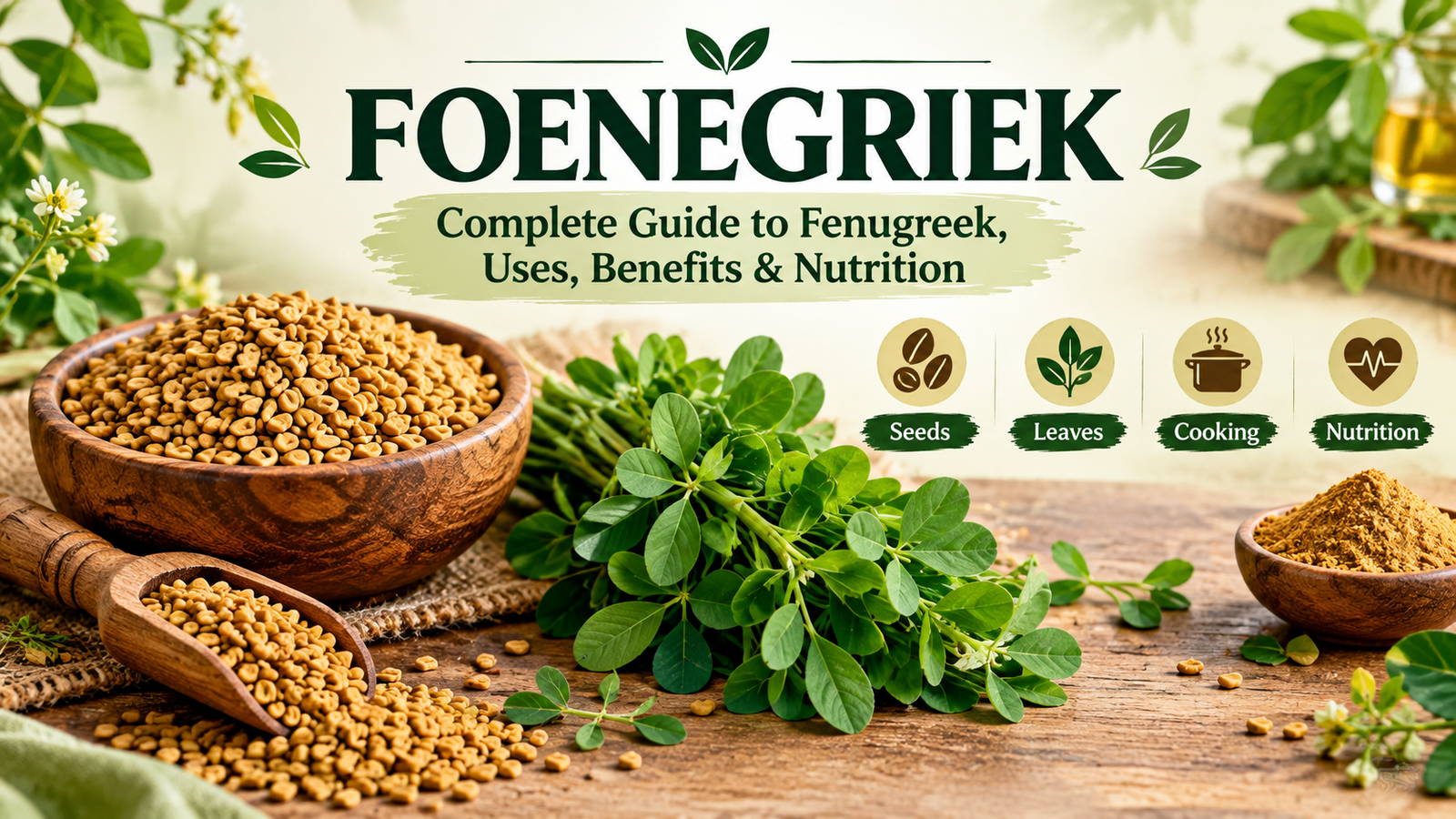
Foenegriek: Complete Guide to Fenugreek, Uses, Benefits, Nutrition, and More Introduction Foenegriek is a name that may look unfamiliar to many English-speaking readers, but the plant behind the word is widely known around the world as fenugreek. Scientifically called Trigonella foenum-graecum, foenegriek is an annual plant belonging to the Fabaceae, or legume, family. It is […]
Foenegriek: Complete Guide to Fenugreek, Uses, Benefits, Nutrition, and More
Introduction
Foenegriek is a name that may look unfamiliar to many English-speaking readers, but the plant behind the word is widely known around the world as fenugreek. Scientifically called Trigonella foenum-graecum, foenegriek is an annual plant belonging to the Fabaceae, or legume, family. It is especially familiar in South Asian, Middle Eastern, Mediterranean, and North African cooking, where both its leaves and seeds are used in different ways. In the Netherlands, the plant is known as fenegriek or foenegriek, while in English it is generally called fenugreek and in South Asian cuisine it is commonly known as methi. Official Dutch botanical records identify Trigonella foenum-graecum as Fenegriek and describe it as an annual plant with greenish-yellow flowers.
Foenegriek is interesting because one plant can provide several different culinary ingredients. The small golden-brown seeds are commonly dried and used as a spice, while the fresh leaves can be cooked as a vegetable or herb and dried leaves can be used to add a distinctive aroma to dishes. The seeds have a characteristic bitter, earthy, nutty flavor and a strong fragrance that can become more noticeable during cooking. Because of this distinctive character, only a relatively small quantity may be needed to influence the taste of a dish. Beyond food, fenugreek has a long history of traditional use, and modern researchers have investigated different components of the plant. However, traditional use should not automatically be interpreted as proof that a particular health claim is medically established.
What Is Foenegriek?
Foenegriek refers to fenugreek, the plant known botanically as Trigonella foenum-graecum. It is a small annual herb that produces trifoliate leaves, small flowers, pods, and hard seeds. The plant belongs to the same broad botanical family as peas, beans, and chickpeas. Its seeds are especially important as a culinary spice, while its leaves are also eaten in many regional cuisines. The American Heritage Dictionary defines fenugreek as a Eurasian plant in the pea family whose mildly bitter seeds and aromatic leaves are used as flavorings.
The terminology can initially create confusion because different languages and regions use different names for the same plant. English speakers are most likely to encounter “fenugreek,” Dutch speakers may encounter “fenegriek” or “foenegriek,” and South Asian cooks commonly know the plant as methi. FloraLexicon lists fenegriek among the Netherlands names associated with Trigonella foenum-graecum and also records many regional names for the same plant. Understanding these names is useful when shopping for spices, reading recipes, researching ingredients, or comparing information from different countries.
Foenegriek, Fenugreek, and Methi: Are They the Same?
One of the most common questions about foenegriek is whether it is different from fenugreek or methi. In the usual culinary and botanical context, these names refer to the same plant, Trigonella foenum-graecum. The differences are primarily linguistic and regional rather than botanical. “Fenugreek” is the familiar English name, “foenegriek” is a Dutch form encountered in the Netherlands and related contexts, and “methi” is widely used in South Asian cooking.
There can still be practical differences when a product is labeled with one of these names because the product may contain different parts of the plant. Fenugreek seeds, fresh fenugreek leaves, and dried fenugreek leaves are not identical ingredients. Seeds have a stronger bitter and aromatic character, while leaves tend to provide a different herbal flavor. Therefore, when following a recipe or purchasing a product, it is important to check whether the package contains seeds, powder, fresh leaves, or dried leaves rather than relying only on the general plant name.
The Appearance and Growth of Foenegriek
Foenegriek is a relatively small annual herb. Dutch botanical records describe Trigonella foenum-graecum as an annual species generally reaching around 0.20 to 0.40 meters in height, with greenish-yellow flowers and seed-bearing fruits. The plant’s compact growth makes it suitable for cultivation in appropriate warm and relatively dry conditions, and fenugreek has become an established crop in several parts of the world.
The plant develops groups of three small leaflets, which is one of its recognizable characteristics. After flowering, it produces pods containing the seeds. These seeds are angular and generally yellowish-brown or golden-brown when mature. Their strong aroma means that the plant can often be recognized not only by its appearance but also by its characteristic smell. In agriculture and home gardening, the plant is valued both as a food crop and as an herb with multiple possible culinary uses.
The History of Foenegriek
Fenugreek has a long history of human use, particularly around the Mediterranean, Middle East, and South Asia. Its Latin scientific name, Trigonella foenum-graecum, contains the expression “foenum graecum,” traditionally translated as “Greek hay.” The English word fenugreek itself developed through older European language forms from this Latin expression. The American Heritage Dictionary traces the English name through Middle English and Old French back to Latin fēnugraecum.
The long history of fenugreek is closely connected with food and traditional practices. Its seeds were valuable because they could be dried and stored, while the leaves could be used when available. Over generations, different culinary traditions developed their own methods for roasting, grinding, soaking, or cooking the seeds. This helps explain why the same plant can taste quite different depending on how it is prepared and what ingredients are combined with it.
What Do Foenegriek Seeds Taste Like?
Foenegriek seeds have a distinctive taste that is difficult to confuse with many other common spices. Raw or insufficiently cooked seeds can be quite bitter, while cooking can produce a warmer and more rounded flavor. Their aroma is often described as earthy, nutty, slightly sweet, and reminiscent of maple syrup. The distinctive aroma is one reason fenugreek can have a noticeable effect on a dish even when used in a small quantity.
The bitterness of the seeds means that preparation matters. If a cook uses too much fenugreek or cooks it incorrectly, the dish can become unpleasantly bitter. On the other hand, when used carefully alongside other spices, the seeds can add depth and complexity. Grinding the seeds changes how quickly their flavor spreads through a dish, while whole seeds can provide a more gradual release of flavor during cooking.
Foenegriek Seeds in Cooking
Foenegriek seeds are widely used as a spice and can be found in numerous regional recipes. They may be used whole, lightly cooked, roasted, or ground into a powder. They can become part of spice mixtures, curries, lentil dishes, vegetable preparations, sauces, pickles, and other foods. In South Asian cooking, fenugreek seeds are one of the ingredients that can contribute a deep and characteristic flavor to particular spice combinations.
The key to cooking with foenegriek is moderation. Because the seeds are powerful, a small quantity can be enough for an entire dish. When whole seeds are used, cooks commonly introduce them at an appropriate stage of cooking so that their flavor can develop without becoming excessively harsh. Ground fenugreek can be incorporated into spice blends or seasoning mixtures, allowing the flavor to spread more evenly throughout the food.
Foenegriek Leaves and Methi
Although the seeds receive a great deal of attention, the leaves are equally important in many culinary traditions. Fresh fenugreek leaves can be cooked with vegetables, legumes, breads, sauces, and other ingredients. Dried leaves are also used as a seasoning and are valued for their strong fragrance. In South Asian cuisine, the word methi can refer to fenugreek and is especially familiar in dishes using its leaves.
The leaves have a different flavor profile from the seeds. They can provide a green, herbal, slightly bitter character that works particularly well with rich sauces, vegetables, dairy-based preparations, and breads. Drying the leaves concentrates their aroma and makes them convenient to store for longer periods. This is one reason fenugreek remains useful even when fresh leaves are not available.
Nutritional Characteristics of Foenegriek
Fenugreek seeds contain several nutrients and naturally occurring plant compounds. Commercial nutrition information for ground fenugreek can show substantial amounts of dietary fiber and protein by weight, although the amount consumed in a typical serving is usually much smaller than 100 grams. One commercial specification, for example, lists ground foenegriek at 25 grams of fiber and 23 grams of protein per 100 grams.
It is important to interpret these numbers realistically. People normally use fenugreek as a spice rather than eating large quantities of the ground seeds at once. Therefore, the nutritional contribution from an ordinary serving will be much lower than the values shown on a per-100-gram label. Nevertheless, the presence of fiber and other plant compounds helps explain why fenugreek has attracted interest beyond its culinary role.
Traditional Uses of Foenegriek
Foenegriek has been used traditionally in various cultures for purposes extending beyond cooking. Historical and traditional practices have included preparations made from the seeds or leaves, including teas, powders, and other forms. Modern online health discussions often mention digestion, blood sugar, lactation, and other possible effects, but these claims need to be considered carefully because the quality and results of research can vary.
The important distinction is between traditional use and established medical evidence. A plant may have been used for generations for a particular purpose without modern clinical research proving that it produces the same effect in humans. This is especially important when people consider concentrated extracts or supplements rather than normal culinary quantities. Foenegriek can be part of a normal diet, but it should not automatically be treated as a medicine simply because it has a long history of traditional use.
Possible Health Interest and Scientific Research
Fenugreek has attracted scientific interest because its seeds contain fiber and a variety of naturally occurring compounds. Researchers have investigated areas including blood glucose, digestion, cholesterol, and other health-related outcomes. Some studies have reported potentially useful effects, but evidence varies according to the preparation, dose, population, and outcome being measured.
For this reason, it is more accurate to say that fenugreek has been studied for possible health effects rather than claiming that it definitely treats particular diseases. Supplements can also provide much larger quantities than ordinary food use, changing the risk-benefit considerations. Anyone considering concentrated fenugreek supplements, especially someone taking prescription medication or managing a medical condition, should discuss the product with a qualified healthcare professional.
Foenegriek and Digestion
The seeds contain considerable fiber, which is one reason fenugreek has traditionally been associated with digestive health. Fiber is an important part of a balanced diet and can influence bowel function and digestive processes. However, the effect of eating a small amount of fenugreek as a spice is not necessarily the same as consuming a concentrated supplement.
Some people may also experience digestive discomfort after consuming larger amounts of fenugreek. Gas, bloating, or other gastrointestinal effects can occur, particularly when a person suddenly increases their intake. This is another reason that culinary use and supplement use should be considered separately.
Foenegriek and Blood Sugar Research
Blood sugar is one of the areas in which fenugreek has received considerable research attention. Some studies have investigated whether fenugreek preparations may influence glucose levels or insulin-related measures. However, results depend on the type of preparation and the characteristics of the people studied, and research evidence should not be interpreted as proof that fenugreek can replace diabetes treatment.
People who take glucose-lowering medication should be particularly cautious with concentrated herbal supplements because combining products that affect blood sugar can potentially create unwanted effects. Normal culinary use is different from taking large supplemental doses. Anyone managing diabetes should discuss regular supplement use with a healthcare professional rather than changing treatment independently.
How to Use Foenegriek in Everyday Cooking
For everyday cooking, foenegriek can be introduced gradually. Whole seeds can be incorporated into spice mixtures or cooked dishes, while ground seeds can be added to seasoning blends. Fresh leaves can be cooked with vegetables or incorporated into breads and sauces, and dried leaves can be crumbled into dishes near the end of cooking to preserve their aroma.
Because the seeds are bitter and strongly flavored, beginners should start with a small quantity. Combining fenugreek with complementary spices can create a more balanced flavor. The best method depends on the recipe, but careful cooking is generally more successful than using a large amount of raw seed. Once a cook becomes familiar with its flavor, it becomes easier to determine the right quantity for different dishes.
Foenegriek in Spice Blends
One of the strengths of foenegriek is its ability to work as part of a larger spice profile. It is rarely necessary for fenugreek to dominate a dish. Instead, a small quantity can provide background depth and an unmistakable aroma. This makes it particularly useful in complex spice mixtures where several ingredients contribute different layers of flavor.
When creating a spice blend, balance is important. Fenugreek’s bitterness can become overpowering if too much is included. Light roasting or controlled cooking can change the flavor, but excessive heating can also make the seeds unpleasant. Experienced cooks therefore tend to treat fenugreek as a strong seasoning rather than a basic bulk ingredient.
Growing Foenegriek at Home
Foenegriek can also be grown by people interested in herbs and edible plants. As an annual plant, it completes its life cycle within one growing season. It generally prefers suitable warmth, sunlight, and well-drained soil. Gardeners growing it for leaves may harvest the greens earlier, while those interested in seeds allow the plant to mature and produce pods.
Growing herbs at home can also help people understand the difference between fresh leaves, dried leaves, and mature seeds. The plant’s development from a small seed into a flowering herb demonstrates why the same species can provide several different culinary ingredients. As with any crop, growing success depends on climate, soil, watering, sunlight, and local growing conditions.
Safety and Important Considerations
Foenegriek is widely consumed as a food ingredient, but more is not always better. Concentrated supplements can provide substantially larger amounts than ordinary cooking. People who are pregnant, breastfeeding, taking medication, managing diabetes, or dealing with allergies should seek professional advice before using fenugreek supplements regularly.
Possible side effects can include digestive discomfort and allergic reactions in susceptible individuals. Because fenugreek belongs to the legume family, people with certain food allergies should take appropriate care. Anyone experiencing an unusual reaction after consuming fenugreek should stop using the product and seek appropriate medical guidance.
Why Foenegriek Is Popular Today
Foenegriek remains popular because it combines culinary versatility with a long cultural history. Modern consumers can encounter it in spice shops, supermarkets, herbal products, recipes, restaurants, and online health discussions. The increased interest in traditional ingredients has also encouraged people to research unfamiliar names and discover that a product called foenegriek may simply be the same ingredient they already know as fenugreek.
Its popularity also demonstrates how food names travel across languages. A person in the Netherlands may search for foenegriek, while someone in Pakistan or India may search for methi, and an English-speaking cook may search for fenugreek. These users can all be looking for the same botanical plant even though the search terms look completely different.
Frequently Asked Questions About Foenegriek
Is foenegriek the same as fenugreek?
Yes. Foenegriek is a name used for fenugreek, botanically known as Trigonella foenum-graecum. Dutch botanical sources identify the plant as Fenegriek, while English sources commonly use the name fenugreek.
Is foenegriek the same as methi?
Yes, in the usual culinary context, methi refers to the same fenugreek plant. However, the specific product may contain seeds, fresh leaves, or dried leaves, so it is useful to check the ingredient description.
What does foenegriek taste like?
Foenegriek seeds have a strong, earthy, nutty, and somewhat bitter taste. Their aroma can also have a sweet, maple-like character. The flavor becomes different depending on whether the seeds are raw, cooked, roasted, or ground.
How is foenegriek used in cooking?
It can be used as whole seeds, ground spice, fresh leaves, or dried leaves. It appears in curries, spice blends, vegetable dishes, breads, sauces, pickles, and many other regional foods.
Is foenegriek healthy?
Fenugreek contains fiber and other plant compounds and has been investigated for several possible health effects. However, research findings vary, and traditional use should not be considered proof that fenugreek treats a disease.
Can foenegriek be used every day?
Small amounts used as a normal cooking spice are common. Regular use of concentrated supplements is different and may require professional advice, particularly for people taking medication or managing a health condition.
Can foenegriek be grown at home?
Yes. Fenugreek is an annual herb that can be grown under suitable conditions. It can be cultivated for its leaves or allowed to mature so that its seed pods can develop.
Why is foenegriek called fenugreek in English?
The two names come from different languages and naming traditions. The English word fenugreek ultimately traces back through older European forms to the Latin faenum graecum, meaning “Greek hay.”
Conclusion
Foenegriek may appear to be an unfamiliar ingredient when encountered in a Dutch recipe, product label, or online search, but it is simply another name associated with the well-known herb fenugreek, scientifically known as Trigonella foenum-graecum. Its seeds and leaves have been used across different culinary traditions for a very long time, and its distinctive flavor makes it a valuable ingredient in spice blends, curries, breads, vegetables, sauces, and other foods. Official Dutch botanical information confirms its identity, while English dictionary sources describe fenugreek as a Eurasian plant in the pea family whose seeds and aromatic leaves are used as flavorings.
The most useful thing to remember about foenegriek is that the name may change while the underlying plant remains the same. Fenugreek, methi, and foenegriek can lead you to the same botanical species, although the particular product may contain seeds or leaves. Its traditional reputation and nutritional characteristics make it an interesting ingredient, but health claims should be considered carefully and separated from established medical evidence. Whether you discover foenegriek while cooking, gardening, shopping for spices, or researching traditional foods, understanding its botanical identity makes it much easier to appreciate its history, flavor, uses, and place in cuisines around the world.