





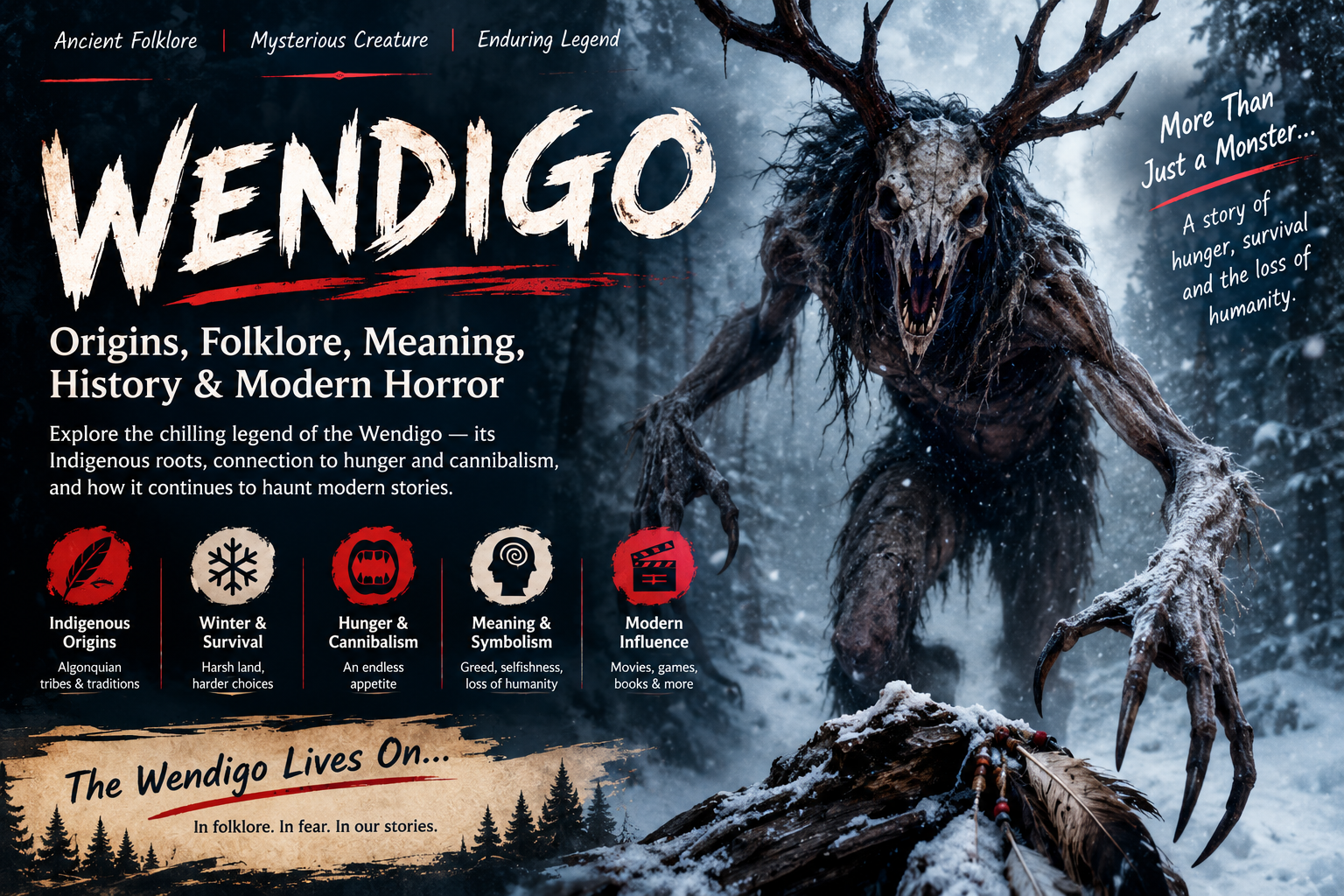
Wendigo: The Complete Guide to Its Origins, Folklore, Meaning, and Modern Influence Introduction The Wendigo is one of the most mysterious and frightening figures associated with the traditional folklore of several Algonquian-speaking peoples of North America. Stories about the Wendigo have been passed down in different forms among communities including the Ojibwe and Cree, and […]
Wendigo: The Complete Guide to Its Origins, Folklore, Meaning, and Modern Influence
Introduction
The Wendigo is one of the most mysterious and frightening figures associated with the traditional folklore of several Algonquian-speaking peoples of North America. Stories about the Wendigo have been passed down in different forms among communities including the Ojibwe and Cree, and the figure is commonly associated with winter, extreme hunger, starvation, cannibalism, greed, and the dangers of losing one’s humanity. Unlike many modern fictional monsters that exist mainly for entertainment, the Wendigo has a deeper cultural background connected to traditional beliefs, social values, survival, and the harsh conditions of northern environments. Historical sources record several different spellings and descriptions, including Windigo, Wiindigoo, and related forms, showing that there was never one single universal description of the figure.
Today, the word Wendigo is especially popular in horror movies, novels, video games, television programs, online stories, and supernatural discussions. Modern entertainment frequently portrays the creature as an extremely tall, thin monster with antlers, a deer-like skull, glowing eyes, or other exaggerated physical characteristics. However, these familiar modern images should not simply be treated as the original traditional description. The historical traditions are much more varied, and in some accounts the Wendigo can be understood not only as a supernatural being but also as a condition associated with destructive hunger, cannibalism, greed, and a departure from ordinary human behavior. Understanding this difference is important when exploring the subject because the Wendigo is connected to Indigenous cultural traditions rather than being merely another fictional monster.
What Is a Wendigo?
A Wendigo is generally described in traditional Algonquian-related folklore as a dangerous supernatural figure connected with hunger, winter, starvation, and cannibalism. Encyclopaedia Britannica describes the Wendigo as appearing in the spiritual traditions of North American Algonquian-speaking peoples and notes that it can be represented either as a frightening being that hunts and consumes humans or as a spirit or condition associated with people becoming cannibalistic. This distinction is important because there is no single appearance or story that represents every tradition. Different communities and historical sources have described the figure in different ways, and the meaning of the Wendigo can be more important than its physical appearance.
The central idea behind the Wendigo is often connected to an appetite that can never be satisfied. A person who becomes associated with the Wendigo is no longer governed by ordinary human limits and may develop an overwhelming desire to consume others. This creates a powerful symbolic contrast between human cooperation and uncontrolled selfishness. In environments where winter could bring severe scarcity and isolation, stories about a supernatural being associated with hunger and cannibalism could communicate serious warnings about the consequences of abandoning social responsibilities. The Wendigo therefore represents much more than physical danger; it can also symbolize excess, selfishness, destructive desire, and the loss of one’s connection to the community.
The Origins of Wendigo Folklore
The origins of Wendigo traditions are associated with several Algonquian-speaking peoples in northern North America. Historical and linguistic records show a number of related spellings and terms, demonstrating that the tradition developed across different communities rather than coming from a single storyteller or a single written source. The University of British Columbia’s Dictionary of Canadianisms on Historical Principles records forms such as Wendigo and Weendigo and traces the word to Algonquian and Ojibwa usage. The Smithsonian’s collections also contain historical works and materials concerning Windigo traditions and Algonquian folklore, reflecting the long history of scholarly interest in the subject.
Because the stories come from oral traditions and different cultural communities, researchers should be careful when presenting one version as the definitive Wendigo story. Descriptions, names, behaviors, and explanations can vary. Some accounts emphasize a supernatural monster, while others place greater emphasis on the possibility that a human being could become associated with the Wendigo through extreme circumstances or morally destructive behavior. This variation is not a weakness in the tradition; it is a normal feature of folklore that develops through generations, languages, communities, and storytelling practices.
Wendigo and the Harshness of Winter
Winter plays an important role in many Wendigo stories and interpretations. Northern winters could historically create difficult conditions involving cold, isolation, limited food supplies, and dangerous travel. In such circumstances, hunger was not simply an unpleasant feeling but could become a genuine survival threat. The association between the Wendigo and winter therefore creates a powerful image of danger emerging from an environment where human beings are vulnerable.
The connection with winter also gives the Wendigo a symbolic dimension. When food becomes scarce and people become isolated, cooperation and sharing can become especially important. A creature representing endless hunger and selfish consumption can therefore function as a warning against behavior that threatens the survival of the wider community. The Wendigo’s hunger is frightening partly because it has no natural stopping point. It is not simply hungry because there is no food; it is portrayed as hungry even after consuming what should have satisfied it.
The Wendigo and Cannibalism
Cannibalism is one of the most disturbing elements associated with Wendigo traditions. In many accounts, the Wendigo’s defining characteristic is its desire to consume human beings. Britannica specifically connects the figure with cannibalism and describes traditions in which a person can become associated with the Wendigo through a supernatural transformation or possession. Historical records also describe the Wendigo as an embodiment of an appetite directed toward human flesh.
The significance of cannibalism in these stories extends beyond horror. It can represent the ultimate violation of social relationships because a human being becomes a threat to other members of the community. Instead of protecting family, friends, and neighbors, the Wendigo figure is driven to consume them. This reversal of normal human behavior makes the story especially powerful. The horror is not simply that a monster might attack someone; it is that hunger, greed, and desperation can symbolically destroy the bonds that make a community possible.
Why Is the Wendigo Always Hungry?
One of the most memorable concepts surrounding the Wendigo is its inability to become satisfied. Traditional accounts vary, but the figure is often connected with an appetite that continues regardless of how much it consumes. Some descriptions portray the Wendigo as extremely thin or emaciated while simultaneously possessing an enormous appetite. This apparent contradiction is central to the symbolism: consumption does not solve the problem because the desire itself has become endless.
The idea can also be interpreted as a warning about excess. Ordinary hunger has a natural limit because food eventually provides nourishment and satisfaction. Wendigo hunger is different because it represents desire without boundaries. The more the creature consumes, the more it wants. As a symbolic figure, therefore, the Wendigo can be connected with greed and uncontrolled consumption. It becomes an image of what can happen when desire is allowed to grow without moderation or responsibility.
What Does a Wendigo Look Like?
There is no single universally accepted physical appearance for the Wendigo. Different historical and cultural accounts have described the figure differently. Some traditions emphasize a frightening human-like or supernatural being, while other descriptions portray it as unusually large, thin, or physically unnatural. The image commonly seen today—a skeletal creature with enormous antlers and a deer skull—is strongly associated with modern horror culture and should not automatically be presented as the traditional form.
This distinction has become particularly important because internet culture has spread a standardized visual image of the Wendigo. Search engines, horror artwork, video games, social media posts, and fantasy illustrations frequently present an antlered monster moving through snowy forests. That image is visually effective for modern horror, but it simplifies a much more complicated cultural tradition. Understanding the historical background allows readers to appreciate why the Wendigo is more significant than a frightening creature design.
Wendigo, Greed, and Human Behavior
One of the most interesting aspects of Wendigo folklore is its connection to human behavior. The figure can be understood as representing the consequences of allowing selfishness, greed, or uncontrolled desire to dominate a person’s actions. Rather than simply asking people to fear a creature hiding in the forest, stories associated with the Wendigo can also be understood as warnings about what happens when someone places personal appetite above the welfare of others.
This interpretation gives the Wendigo a psychological and social dimension. A person does not have to believe in supernatural monsters to understand the underlying warning. Modern societies still discuss excessive consumption, greed, selfishness, and the dangers of placing individual desires above community needs. The Wendigo remains compelling partly because these themes are understandable even outside the cultural environment in which the original traditions developed.
The Wendigo in Modern Horror
The Wendigo has become a major figure in modern horror and popular culture. Writers, filmmakers, game developers, artists, and television creators have repeatedly adapted the concept to create stories about mysterious creatures living in remote forests. The modern version is often portrayed as fast, frightening, physically unnatural, and connected to cold wilderness settings. This version has helped introduce the word to audiences around the world.
Literature played an important role in bringing the Wendigo concept into modern popular culture. Algernon Blackwood’s 1910 story The Wendigo became an influential literary treatment of the subject and helped establish the creature as a recognizable figure in supernatural fiction. Later works continued to reinterpret the concept, often combining the traditional idea with European-style monster imagery, wilderness horror, body horror, and supernatural suspense.
Wendigo in Movies, Television, and Video Games
Modern entertainment has expanded the Wendigo far beyond traditional folklore. In video games, the creature can function as an enemy that hunts players through forests, caves, mountains, or abandoned locations. In television and film, it is often used to create suspense by combining isolation, darkness, snow, and supernatural danger. These stories may borrow the name and some basic concepts while changing the creature’s appearance, abilities, origins, and behavior.
Because popular culture frequently changes traditional figures, audiences should distinguish between a modern fictional Wendigo and the cultural traditions from which the name originated. A horror game may portray an antlered creature with supernatural speed, while a traditional account may focus much more strongly on hunger, cannibalism, social behavior, winter, or spiritual transformation. Both can be discussed, but they should not be presented as identical.
Why the Wendigo Remains Popular
The Wendigo continues to attract attention because it combines several elements that naturally create compelling stories: wilderness, isolation, winter, hunger, transformation, supernatural fear, and the possibility of losing one’s humanity. Unlike a monster whose only purpose is physical destruction, the Wendigo can also represent an internal danger. The frightening question becomes not only “What is hiding in the forest?” but also “What could a person become under extreme circumstances?”
This combination makes the Wendigo particularly effective in modern storytelling. It can be used as a monster, a symbol, a metaphor, or a cultural subject. Its connection with cold wilderness environments also gives writers and filmmakers a natural setting for suspense. A quiet snowy forest, limited visibility, isolation from civilization, and the fear of running out of food can all contribute to an atmosphere of uncertainty.
Wendigo Folklore and Cultural Respect
When discussing the Wendigo, cultural respect is important because the concept comes from Indigenous traditions that are connected to real communities and histories. Treating the Wendigo only as a decorative horror monster can remove the cultural context that gives the figure its deeper meaning. Researchers and writers should therefore distinguish between documented traditional beliefs and later fictional inventions.
It is also important to avoid presenting every story about the Wendigo as though it comes from one unified Indigenous belief system. Algonquian-speaking peoples include many distinct communities with their own languages, traditions, and histories. Historical records demonstrate variation in the terminology and descriptions associated with the figure. A responsible article should therefore use terms such as “some traditions,” “historical accounts,” or “certain communities” when appropriate rather than claiming that every Indigenous community has exactly the same Wendigo story.
Wendigo vs. the Modern Antlered Monster
The antlered Wendigo is probably the image most people recognize today, but it is useful to understand that this image is largely a product of modern popular culture. Contemporary horror frequently combines the Wendigo name with deer-like anatomy, skeletal bodies, elongated limbs, sharp teeth, and supernatural powers. These elements create a recognizable visual language for horror but should not automatically be treated as ancient or universal characteristics.
The older traditions are more diverse and can focus on spiritual danger, hunger, cannibalism, transformation, and moral behavior rather than a specific monster design. This is one reason the Wendigo is such an interesting subject for research. Its modern image tells us something about contemporary horror, while the older traditions tell us something about the cultural meanings attached to hunger, survival, community, and excess.
Is the Wendigo Real?
There is no reliable scientific evidence establishing the Wendigo as a physically existing supernatural creature. The Wendigo is best discussed in the context of folklore, traditional belief, literature, and popular culture rather than as a scientifically documented animal or monster. Historical records and museum collections demonstrate that Wendigo traditions have been documented, but documentation of a belief is not scientific proof that the supernatural creature exists.
The distinction between folklore and physical evidence is important when discussing mysterious creatures. Many legendary beings have played important roles in human culture without being scientifically verified as real animals. The Wendigo belongs to this broader world of mythology and folklore while also having a specific Indigenous cultural history that deserves to be understood on its own terms.
The Continuing Influence of the Wendigo
The Wendigo continues to influence writers, artists, game developers, filmmakers, researchers, and folklore enthusiasts. Its themes remain useful because they deal with questions that have not disappeared: How does extreme hunger affect people? What happens when individuals put personal desire above community survival? Why do humans create stories about dangerous wilderness? How can fear be used to communicate social values?
Modern interest in the Wendigo also demonstrates how traditional stories can change when they enter global popular culture. A figure rooted in particular cultural traditions can eventually appear in books, games, movies, internet horror stories, and artwork created thousands of miles away from its original cultural setting. This process can create fascinating new fiction, but it also makes it more important to remember the historical and cultural context behind the name.
FAQ About the Wendigo
What is a Wendigo?
The Wendigo is a supernatural figure associated with traditional folklore among several Algonquian-speaking peoples of North America. It is commonly connected with winter, hunger, starvation, cannibalism, and an insatiable appetite. Different communities and historical sources provide different descriptions and interpretations.
Is the Wendigo a real creature?
There is no scientific evidence showing that the Wendigo exists as a physical supernatural creature. It is primarily understood through folklore, traditional belief, literature, and popular culture.
What does a Wendigo look like?
There is no single traditional appearance shared across all Wendigo traditions. Some accounts describe a frightening or supernatural human-like figure, while modern horror commonly depicts the Wendigo as a tall, skeletal creature with antlers. The familiar antlered design should not automatically be treated as the universal traditional form.
Why is the Wendigo associated with cannibalism?
Cannibalism is one of the central themes associated with many Wendigo traditions. The idea represents an extreme violation of ordinary social behavior and is connected to the figure’s insatiable hunger and destructive appetite.
Why is the Wendigo associated with winter?
Winter is important because traditional Wendigo stories developed in northern environments where cold, isolation, hunger, and food scarcity could create serious dangers. The Wendigo’s association with winter reinforces its themes of starvation and survival.
Is every Wendigo story the same?
No. Wendigo traditions vary between communities, languages, historical periods, and sources. Different descriptions and interpretations exist, so it is inaccurate to assume that there is one definitive Wendigo story.
Did the Wendigo originate in modern horror?
No. The Wendigo has roots in Indigenous traditions that predate modern horror fiction. However, modern books, movies, television, and games have significantly changed how the creature is represented today.
Why does the Wendigo have antlers in modern artwork?
Antlers have become a popular visual feature in modern Wendigo artwork and horror fiction. However, the antlered monster should be understood as a modern representation rather than automatically assuming that every traditional account described the figure this way.
Conclusion
The Wendigo is far more than a frightening monster from modern horror stories. Its roots are connected to the traditional beliefs and folklore of several Algonquian-speaking peoples, where the figure is associated with hunger, winter, starvation, cannibalism, excess, and the danger of losing one’s humanity. Historical sources show that the traditions are diverse, with different names, descriptions, and interpretations appearing across communities and periods.
Modern popular culture has transformed the Wendigo into a recognizable horror icon, often depicting it as a skeletal, antlered creature living in a frozen forest. While this version can be effective as fictional entertainment, it represents only one modern interpretation of a much older and more complex tradition. The deeper significance of the Wendigo comes from the themes surrounding uncontrolled hunger, selfishness, survival, community responsibility, and the frightening possibility of losing one’s humanity.
For anyone interested in mythology, Indigenous folklore, supernatural stories, horror fiction, or cultural history, the Wendigo remains an important and fascinating subject. Learning about its traditional context alongside its modern representations provides a more complete understanding of why this figure has survived in cultural memory and why it continues to appear in stories around the world.