





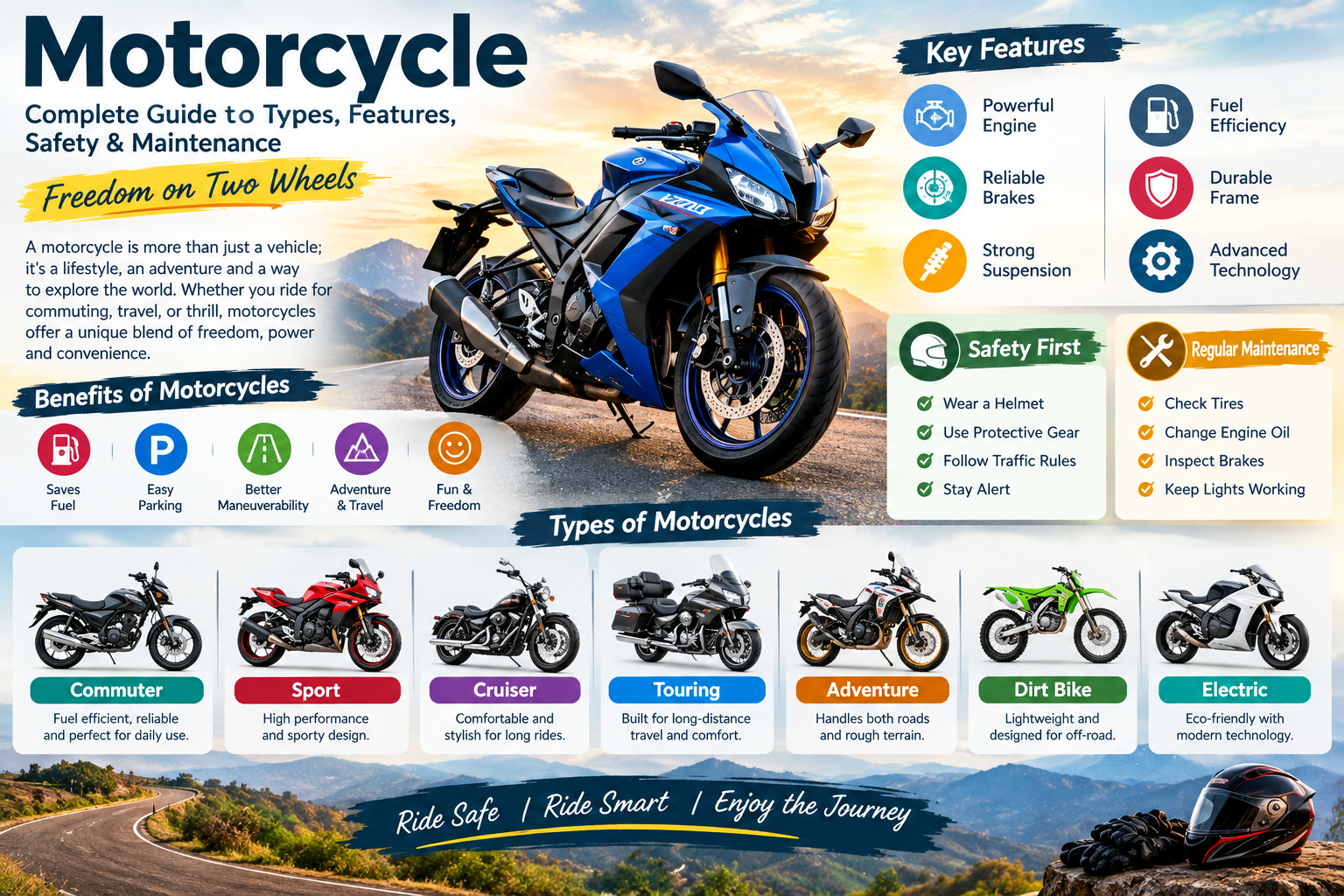
Motorcycle: A Complete Guide to Motorcycles, Their Types, Features, Benefits, and Uses Introduction A motorcycle is one of the most popular forms of two-wheeled transportation in the world. Known for its compact design, fuel efficiency, maneuverability, and distinctive riding experience, the motorcycle has become much more than a simple method of getting from one place […]
Motorcycle: A Complete Guide to Motorcycles, Their Types, Features, Benefits, and Uses
Introduction
A motorcycle is one of the most popular forms of two-wheeled transportation in the world. Known for its compact design, fuel efficiency, maneuverability, and distinctive riding experience, the motorcycle has become much more than a simple method of getting from one place to another. Motorcycles are used for daily commuting, long-distance touring, recreation, professional racing, delivery services, adventure travel, and even specialized work. Their relatively small size allows riders to move through traffic more easily than many larger vehicles, while their mechanical design provides a direct connection between the rider, the road, and the machine. Over time, motorcycle technology has developed significantly, introducing improved engines, advanced braking systems, electronic controls, better suspension, stronger frames, improved lighting, and more efficient fuel systems. Today, motorcycles are available in many different shapes and sizes, allowing people to select models according to their transportation needs, riding experience, budget, and personal interests.
The word motorcycle generally refers to a motor-powered two-wheeled vehicle designed to transport one or more people. Although motorcycles share basic characteristics, they can be very different from one another. A lightweight commuter motorcycle may be designed for economical city transportation, while a large touring motorcycle may be built for comfortable journeys covering hundreds or thousands of kilometers. Sport motorcycles focus on acceleration, handling, and performance, whereas adventure motorcycles are designed to handle a combination of paved roads and less-developed surfaces. Understanding these differences is important for anyone interested in purchasing, riding, maintaining, or simply learning about motorcycles. This complete guide explores the meaning of motorcycles, their major types, important components, benefits, safety considerations, maintenance requirements, and the factors that should be considered before choosing a motorcycle.
What Is a Motorcycle?
A motorcycle is a powered two-wheeled vehicle that normally uses an internal-combustion engine or an electric motor to produce movement. Most motorcycles have a frame, wheels, suspension, steering system, braking system, drivetrain, seat, handlebars, and controls that allow the rider to operate the machine. Traditional motorcycles commonly use gasoline-powered engines, while modern electric motorcycles use batteries and electric motors. The size and configuration of these components vary according to the motorcycle’s purpose. For example, a lightweight city motorcycle may have a relatively small engine and simple construction, while a high-performance motorcycle can have a much larger engine, sophisticated suspension, powerful brakes, and electronic rider-assistance systems.
Motorcycles are generally designed around the principle of balance and controlled movement. Unlike a car, a motorcycle does not remain upright in the same way when stationary and relies on the rider’s control, wheels, steering, and physical balance. During normal riding, the rider interacts continuously with the motorcycle by controlling acceleration, braking, steering, body position, and speed. This direct interaction is one of the characteristics that makes motorcycles attractive to enthusiasts while also making proper training and responsible riding particularly important.
History and Development of Motorcycles
The history of motorcycles is closely connected with the development of bicycles, engines, and early motor vehicles. Early motorized two-wheelers were relatively simple machines that combined bicycle-style frames with small engines. As mechanical engineering improved, manufacturers developed stronger frames, more reliable engines, improved suspension systems, and better braking technology. Motorcycle production eventually expanded from small-scale experimentation into a major global industry.
During the twentieth century, motorcycles became increasingly diverse. Manufacturers introduced lightweight commuter models, powerful road motorcycles, racing machines, touring motorcycles, off-road bikes, and specialized utility vehicles. Motorcycle racing also contributed to technological development because manufacturers could test engines, suspension systems, braking components, tires, and aerodynamic designs under demanding conditions. Many technologies developed or refined through competition later influenced road motorcycles. Today, motorcycles continue to evolve through electronic fuel injection, anti-lock braking systems, traction-control systems, riding modes, digital displays, smartphone connectivity, improved batteries, and electric powertrains.
Major Types of Motorcycles
Standard and Commuter Motorcycles
Standard motorcycles are among the most versatile types because they are designed for general-purpose riding. Their riding position is usually relatively upright, making them suitable for everyday transportation and a variety of road conditions. Commuter motorcycles often prioritize fuel economy, reliability, affordable maintenance, and practical operation. They are particularly useful for people who travel regularly through busy urban areas and need a vehicle that can be parked easily and operated economically.
The simplicity of many commuter motorcycles can also make them attractive to new riders. They are often lighter than larger touring or adventure motorcycles and may be easier to handle at lower speeds. However, even a small motorcycle requires proper training because its size does not eliminate the risks associated with traffic, road conditions, weather, and other vehicles.
Sport Motorcycles
Sport motorcycles are designed with an emphasis on performance, acceleration, cornering ability, braking, and responsive handling. They typically feature aggressive styling, a forward-leaning riding position, performance-oriented suspension, and engines designed to deliver strong power. Some sport motorcycles are built primarily for road use, while others are closely related to machines designed for racing.
Because sport motorcycles can offer significant performance, riders need to understand the importance of experience and responsible speed management. Owning a powerful motorcycle does not mean that every ride should involve high-speed riding. Good riding technique, awareness of surroundings, appropriate protective equipment, and respect for speed limits are essential regardless of motorcycle type.
Cruiser Motorcycles
Cruiser motorcycles are recognized for their relaxed riding position, low seat height, distinctive styling, and emphasis on comfortable road riding. Many cruisers are associated with long, open-road journeys and a strong motorcycle culture built around customization, touring, and social riding. Their engines often emphasize smooth power delivery and strong low- to mid-range performance rather than the high-revving characteristics associated with some sport motorcycles.
Cruisers can be appealing to riders who enjoy a relaxed pace and traditional motorcycle styling. They are also frequently customized with different seats, handlebars, exhaust systems, luggage, windshields, and other accessories. The weight and dimensions of some large cruisers, however, can make them more demanding to maneuver at very low speeds, especially for inexperienced riders.
Touring Motorcycles
Touring motorcycles are specifically designed for long-distance travel. They commonly feature comfortable seats, wind protection, large fuel tanks, luggage capacity, passenger accommodations, and technology designed to make extended rides easier. Some premium touring motorcycles include advanced navigation systems, electronic suspension, heated equipment, cruise control, and sophisticated audio or communication systems.
The major advantage of a touring motorcycle is its ability to combine the freedom of two-wheeled travel with features intended for comfort over long distances. Riders planning extended journeys should still consider weather, road conditions, fuel availability, fatigue, and the availability of maintenance services along their route.
Adventure Motorcycles
Adventure motorcycles are designed for riders who want to travel across a combination of paved roads and less-developed surfaces. They generally provide relatively long suspension travel, durable construction, upright ergonomics, and luggage options. Some models are optimized more strongly toward off-road use, while others are primarily road-oriented but capable of handling gravel roads and moderate unpaved terrain.
Adventure riding has become increasingly popular because it allows riders to combine transportation with exploration. However, larger adventure motorcycles can be physically demanding when riding on loose surfaces. Riders should develop appropriate off-road skills gradually rather than assuming that the motorcycle’s design automatically makes difficult terrain easy to navigate.
Dirt Bikes and Off-Road Motorcycles
Dirt bikes are lightweight motorcycles designed primarily for riding on unpaved surfaces. They usually have long-travel suspension, knobby tires, high ground clearance, and relatively simple construction. These motorcycles are commonly used for recreational trail riding, motocross, training, and other forms of off-road riding.
Off-road motorcycles are designed for environments where paved-road motorcycles may struggle. Riders should use suitable protective equipment and ride in areas where motorcycles are legally permitted. Off-road conditions can change quickly because of mud, rocks, sand, water, steep slopes, and uneven terrain, making rider skill particularly important.
Important Motorcycle Components
A motorcycle contains numerous components that work together to provide movement, control, and safety. The engine or electric motor provides the primary source of power, while the drivetrain transfers that power to the rear wheel in most conventional motorcycles. The frame provides the basic structure of the machine, while the suspension helps absorb bumps and maintain tire contact with the road.
Brakes are among the most important components because they allow riders to reduce speed and stop. Modern motorcycles may use disc brakes and, on many models, anti-lock braking systems designed to help prevent wheel lock during hard braking. Tires are equally important because they provide the contact between the motorcycle and the road. Tire condition, correct pressure, tread depth, and suitability for the riding environment can significantly affect handling and braking.
The steering system includes the handlebars, front fork, and related components that allow the rider to control direction. Lights and indicators help the motorcycle communicate with other road users, especially at night or in poor visibility. Modern motorcycles may also include electronic control units, sensors, digital displays, traction control, riding modes, and connectivity systems.
Benefits of Riding a Motorcycle
One major benefit of motorcycles is their relatively compact size. In many urban environments, motorcycles can be easier to park and maneuver than larger vehicles. Their smaller physical footprint can make them practical for commuters who regularly travel through congested areas. Fuel consumption can also be relatively low on many smaller motorcycles, although actual efficiency depends on the model, engine, riding style, traffic, and maintenance.
Motorcycles can also provide an enjoyable recreational experience. Riders often appreciate the sense of freedom, direct interaction with the environment, and opportunity to explore roads and destinations in a different way. Motorcycle communities can provide opportunities for social interaction through organized rides, clubs, events, training activities, and touring groups.
Another benefit is the wide range of motorcycle designs available. A person interested in economical transportation can choose a small commuter motorcycle, while someone interested in long-distance travel can choose a touring model. Similarly, enthusiasts can select sport, cruiser, adventure, or off-road motorcycles depending on their interests.
Motorcycle Safety
Motorcycle safety should always be treated as a fundamental part of riding. Unlike occupants inside a car, motorcyclists have less physical protection surrounding them, which means falls and collisions can result in serious injuries. Wearing appropriate protective equipment is therefore extremely important. A properly fitted helmet is one of the most important pieces of motorcycle safety equipment, while jackets, gloves, riding trousers, and suitable boots can provide additional protection.
Safe riding also requires awareness of traffic and road conditions. Riders should maintain an appropriate following distance, anticipate the actions of other road users, use signals correctly, and avoid unnecessary speeding. Visibility is another important consideration because motorcycles can be harder for some drivers to notice. Riders should use appropriate lighting, positioning, and defensive riding techniques to improve their ability to anticipate hazards.
Training is equally important. New riders should learn basic motorcycle controls and handling in a controlled environment before entering complex traffic situations. Professional motorcycle training can help riders develop braking, cornering, emergency response, and hazard-awareness skills. Experience should be developed gradually rather than through unnecessary risk-taking.
Motorcycle Maintenance
Regular maintenance helps a motorcycle operate reliably and can identify problems before they become more serious. Basic maintenance includes checking tire pressure and condition, engine oil or other required fluids, brakes, chain condition, lights, battery condition, and controls. The exact maintenance schedule depends on the motorcycle model and manufacturer recommendations.
The chain is particularly important on motorcycles that use chain drive. It needs appropriate cleaning, lubrication, and adjustment. Tires should be inspected regularly for damage and wear, while brake components should be checked for appropriate condition. Engine oil should be changed according to the manufacturer’s recommended interval. Electrical components, filters, spark plugs, coolant, and other systems may also require periodic inspection or replacement.
A well-maintained motorcycle can provide more predictable performance and reduce the likelihood of mechanical problems during a journey. Riders should keep records of major maintenance work and follow the service schedule specified for their particular motorcycle.
Choosing the Right Motorcycle
Choosing a motorcycle should begin with identifying how and where it will be used. Someone who primarily travels short distances through a city may have very different requirements from someone planning long-distance touring or off-road adventures. Engine size, weight, seat height, fuel consumption, riding position, luggage capacity, maintenance costs, insurance, availability of parts, and purchase price are all factors worth considering.
Experience level should also be considered. A new rider may benefit from a motorcycle that is manageable, predictable, and suitable for learning fundamental riding skills. Experienced riders may want specialized features or performance characteristics based on their preferred type of riding. A motorcycle should not be selected only because it looks attractive; ergonomics and practical suitability are equally important.
Motorcycles and Modern Technology
Modern motorcycles increasingly incorporate technology that was once associated primarily with cars. Digital instrument panels can display speed, engine information, fuel levels, navigation, and other data. Some motorcycles provide multiple riding modes that adjust engine response or electronic systems according to conditions. Traction control and anti-lock braking can provide additional assistance in certain situations.
Electric motorcycles are another important development. Instead of gasoline engines, they use electric motors powered by rechargeable battery packs. Electric motorcycles can provide quiet operation and strong immediate motor response, although range, charging infrastructure, battery cost, and charging time remain important considerations when choosing one.
Motorcycle Travel and Adventure
Motorcycle travel offers a distinctive way to explore different places. Riders can experience landscapes, roads, towns, and natural environments more directly than they might from inside a closed vehicle. Long-distance motorcycle travel requires preparation, however. Riders should consider route planning, weather forecasts, fuel stops, accommodation, luggage, emergency equipment, communication methods, and rest periods.
Fatigue is particularly important on long journeys. A rider who becomes tired may experience slower reactions and reduced concentration. Regular breaks and sensible daily distances can make a journey safer and more enjoyable. Motorcycle touring should be approached as a balance between adventure and preparation rather than simply covering the maximum possible distance.
Frequently Asked Questions About Motorcycles
What is a motorcycle?
A motorcycle is a motor-powered two-wheeled vehicle designed primarily for transporting a rider and, depending on the model, a passenger. Motorcycles can use gasoline engines or electric motors and are available in many different designs.
What are the main types of motorcycles?
Common categories include standard or commuter motorcycles, sport motorcycles, cruisers, touring motorcycles, adventure motorcycles, and dirt or off-road motorcycles. Each type is designed around different riding conditions and purposes.
Are motorcycles good for daily commuting?
Many motorcycles are well suited to daily commuting because they are compact, relatively economical, and easy to park. The most suitable model depends on traffic conditions, travel distance, road quality, weather, and the rider’s experience.
How often should a motorcycle be serviced?
Service intervals vary by motorcycle and manufacturer. Riders should follow the maintenance schedule in the owner’s manual and regularly inspect items such as tires, brakes, fluids, lights, battery, and drivetrain components.
Is a motorcycle difficult to ride?
Learning to ride requires practice because the rider must coordinate balance, steering, acceleration, braking, and body position. Professional training and gradual practice can help new riders develop these skills safely.
What safety equipment should motorcycle riders use?
A properly fitted helmet is essential in places where required and is a key part of motorcycle safety. Riders can also use protective jackets, gloves, riding trousers, and motorcycle-specific boots to provide additional protection.
What is an electric motorcycle?
An electric motorcycle uses an electric motor and rechargeable battery instead of a conventional gasoline engine. Electric motorcycles can offer quiet operation and strong immediate acceleration, while range and charging requirements are important factors to consider.
Which motorcycle is best for beginners?
There is no single motorcycle that is best for every beginner. A suitable beginner motorcycle is generally one that the rider can comfortably control, manage at low speeds, and operate confidently while learning fundamental riding skills.
Conclusion
Motorcycles have developed from relatively simple motorized two-wheelers into sophisticated machines available for commuting, touring, recreation, competition, adventure, and everyday transportation. Their compact size, variety of designs, mechanical character, and direct riding experience continue to attract millions of people around the world. From economical commuter motorcycles and practical standard models to sport bikes, cruisers, touring machines, adventure motorcycles, and electric motorcycles, there is a wide range of choices for different riding requirements.
Understanding a motorcycle involves more than knowing its engine size or appearance. Riders should learn about the motorcycle’s components, maintenance requirements, safety equipment, handling characteristics, and intended use. Choosing an appropriate motorcycle requires consideration of experience, budget, riding environment, comfort, maintenance, and personal goals. With responsible riding habits, regular maintenance, appropriate protective equipment, and proper training, motorcycles can be practical transportation machines as well as a rewarding form of recreation and travel. As technology continues to advance, motorcycles are likely to become increasingly connected, efficient, and sophisticated while maintaining the fundamental two-wheeled experience that has made them popular for generations.